AI for Dental Scheduling Optimization: What Works, What Doesn't, and When to Just Use a Spreadsheet
Most dental scheduling 'AI' is rule-based automation with better marketing. For small practices, exporting your schedule data to a CSV and running it through ChatGPT will often reveal the same insights that a $300/month scheduling tool would, with more control and less vendor lock-in. Dedicated AI scheduling tools start making sense when you have enough data volume and enough complexity that manual analysis breaks down.

Scheduling in a small dental practice is a puzzle that never stays solved. You fill the book for next Tuesday, and by Monday afternoon two patients have canceled, a hygiene patient needs an emergency exam, and the 2 PM crown prep is running 40 minutes behind because the morning extraction had a complication. The front desk is juggling phone calls, trying to fill the holes without double-booking Dr. Patel, and doing it all from memory and a color-coded paper schedule (or a digital calendar that’s functionally the same thing).
This is the reality for practices with one to five operatories. You don’t have a scheduling department. You have one or two front desk staff who know your providers’ preferences, your patients’ habits, and the unwritten rules of your practice’s flow. When it works, it works because those people are good at their jobs. When it breaks (turnover, sick days, growth beyond what one person can track), the whole schedule falls apart.
The AI scheduling vendors know this. They also know that “AI-powered scheduling” sounds like the fix. But what does AI scheduling actually mean for a small dental practice? What are these tools doing under the hood? And when does it make more sense to use ChatGPT and a spreadsheet instead of paying for a dedicated platform?
Testing honesty: We have not had hands-on access to every scheduling tool discussed in this guide. Where we describe product capabilities, we’re working from publicly available documentation, vendor marketing materials, published case studies, and user reports. We have tested the ChatGPT/CSV analysis workflow described in this guide using sample scheduling data. When we’re speculating, we say so.
The Scheduling Pain Points That Actually Matter
Before evaluating any tool, AI or otherwise, it helps to name the specific problems. Not all scheduling problems are the same, and not all of them benefit from the same solution.
No-shows and late cancellations. Published research on dental appointment no-show rates puts the average somewhere between 10% and 30%, depending on practice type, patient demographics, and geography. For a solo GP seeing 12-15 patients a day, a 15% no-show rate means losing one to two patient slots daily. Over a month, that’s $8,000-$15,000 in lost production, depending on your procedure mix. The ADA Health Policy Institute has published data showing that unfilled appointments remain one of the largest controllable production losses for small practices.
Hygiene recall gaps. The standard six-month recall interval is a convention, not a clinical absolute. Some patients need three-month intervals (periodontal maintenance). Some healthy patients could go nine months without issues. Most practices treat the recall interval as fixed because tracking individualized intervals across 2,000 active patients is logistically painful. The result is a one-size-fits-all recall system that over-schedules some patients and under-schedules others.
Cancellation slot filling. When a 90-minute crown prep cancels at 3 PM on Thursday, you need to fill that slot with something productive, ideally by Wednesday evening, so the patient can plan. Most practices rely on a short-call list and a front desk person who remembers which patients are flexible. This works when the list is current and the person is available. It doesn’t scale.
Provider utilization imbalance. In multi-provider practices, one dentist is booked three weeks out while the associate has same-week availability. This is usually a patient preference issue, a scheduling rule issue, or both. Fixing it requires understanding why the imbalance exists, not just shuffling appointments.
What AI Scheduling Tools Claim vs. What They Actually Do
A handful of companies market AI-powered scheduling for dental practices. The feature set they advertise generally includes predictive no-show analysis, automated waitlist management, intelligent slot matching, and optimized recall scheduling. Here’s what the technology behind those features typically looks like.
Predictive no-show scoring. The most technically legitimate AI feature in scheduling. A machine learning model analyzes patient history (previous no-shows, appointment lead time, day of week, procedure type, weather patterns, time since last visit) and assigns a probability that a given patient will miss their appointment. Practices can then double-book high-risk slots, send additional reminders to likely no-shows, or require deposits. This genuinely requires ML and improves with more data.
Automated waitlist management. When a slot opens, the system contacts patients on the waitlist via text or email, in priority order, and books the first one who confirms. This is useful automation, but it’s not AI in a meaningful sense. It’s a queue with automated outreach. Some tools add a ranking layer (preferring patients who are clinically overdue or who match the open slot’s duration), which starts approaching intelligent matching.
Recall interval optimization. The claim is that AI analyzes clinical data to recommend personalized recall intervals instead of blanket six-month scheduling. In theory, a model could look at periodontal measurements, caries history, risk factors, and adherence patterns to suggest three-month, six-month, or nine-month intervals per patient. In practice, most “optimized recall” features are still rule-based: if the patient has a perio diagnosis code, set recall to three months. That’s a lookup table, not a learning algorithm.
Schedule density optimization. The claim is that AI arranges appointments to minimize gaps and maximize provider utilization. What most tools actually do is apply constraint satisfaction: given provider availability, procedure duration, operatory requirements, and patient preferences, find the best available slot. This is the same type of optimization that airline booking systems and restaurant reservation platforms use. It’s computationally useful, but it’s operations research, not necessarily the kind of AI the marketing implies.
Using ChatGPT to Analyze Your Own Scheduling Data
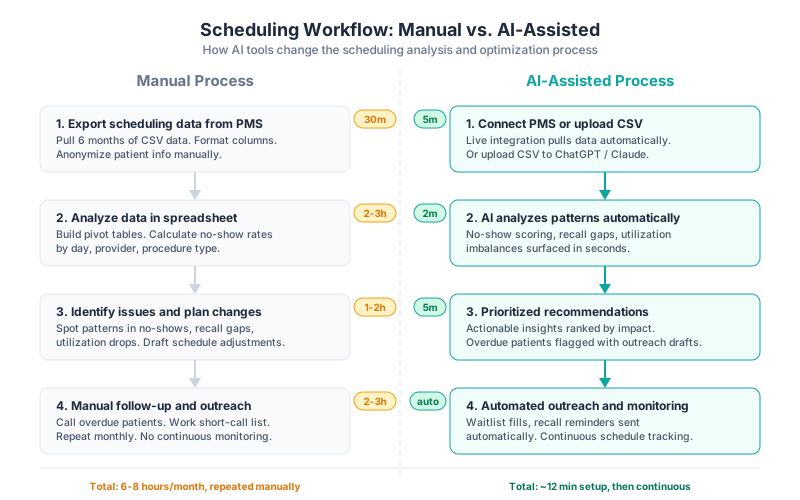
Here’s the approach that costs nothing and often reveals more than you’d expect. If your practice management software lets you export scheduling data (and most do, including Dentrix, Eaglesoft, Open Dental, and CareStack), you can run that data through ChatGPT or Claude and get actionable analysis.
Step 1: Export Your Data
Pull a scheduling report covering at least six months. You want columns for: appointment date, appointment time, provider, patient ID (anonymized is fine; use a patient number, not a name), procedure code or category, scheduled duration, actual status (completed, no-show, canceled, rescheduled), and if available, when the appointment was booked (lead time).
Export to CSV. Most PMS reporting modules can do this directly. If you are on Dentrix Ascend, the reporting module handles CSV exports, and the platform’s “smart scheduling” features (which are rule-based automation, not AI) can enforce provider preferences and procedure durations. If yours only exports to PDF, you can often copy the data into a spreadsheet and save as CSV.
Step 2: Upload and Prompt
Upload the CSV to ChatGPT (GPT-4 with Code Interpreter/Advanced Data Analysis) or Claude and use prompts like these:
No-show pattern analysis:
“Analyze this scheduling data and identify patterns in no-shows. Break down no-show rates by: day of week, time of day, provider, procedure type, and appointment lead time (how far in advance the appointment was booked). Flag any patient IDs with three or more no-shows in the dataset.”
Hygiene recall gap analysis:
“For patients with procedure codes D0120 (periodic exam) and D1110 (prophylaxis), calculate the average interval between appointments per patient. Identify patients whose average interval exceeds 7 months. Also identify patients currently more than 8 months since their last hygiene visit. These are overdue for outreach.”
Schedule utilization analysis:
“Calculate the daily utilization rate for each provider, defined as total scheduled appointment minutes divided by total available chair minutes (assume 8 hours per provider day). Show this as a weekly trend. Identify the days with the lowest utilization for each provider.”
Step 3: Generate Recall Messages
Once you’ve identified overdue patients, you can use ChatGPT to draft recall outreach. Example prompt:
“Write 3 variations of a friendly text message reminding a dental patient that they’re overdue for their cleaning and exam. Keep each under 160 characters. Tone should be warm but professional, not pushy. Include a way for them to reply to schedule. Don’t use exclamation marks in more than one variation.”
Or for a cancellation fill attempt:
“Write a text message for a patient on our short-call list letting them know we have an opening tomorrow afternoon for a cleaning appointment. Keep it under 160 characters. Include the practice phone number 555-0123.”
These messages need review before sending (check tone, accuracy, and compliance with your state’s patient communication rules), but the drafting time drops from ten minutes to thirty seconds.
When a Dedicated AI Scheduling Tool Is Worth It
The ChatGPT/CSV approach has real limitations. You’re working with static data exports, not live schedule integration. You can’t automate actions; every insight requires manual follow-up. And you’re doing the analysis periodically rather than continuously.
A dedicated AI scheduling tool starts earning its cost when:
You have enough volume to make predictions useful. A solo practitioner seeing 10 patients a day generates about 2,500 appointments per year. That’s thin data for a machine learning model. A three-provider practice with two hygienists generating 15,000+ appointments annually has enough data for patterns to stabilize and predictions to improve.
Your no-show rate is above 15% and costing you measurably. If your no-show rate is 8% and you’re a solo practice, a scheduling AI might save you one appointment per week. At $200 average production per appointment, that’s $800/month in recovered revenue against a tool cost of $200-$400/month. The math is tight. At 20% no-shows across three providers, the recovery potential jumps and the ROI clears.
Your front desk is the bottleneck. If your scheduling coordinator is already at capacity (fielding calls, working the waitlist, managing recalls) and you’re choosing between hiring another person or adding software, the software is almost always cheaper. A scheduling AI that automates waitlist outreach, sends smart reminders, and fills cancellation slots can replace 10-15 hours per week of front desk phone work.
You’re growing and your current system isn’t scaling. When you move from one provider to two, or from three operatories to five, the scheduling complexity doesn’t increase linearly; it multiplies. More providers mean more preference rules, more operatory conflicts, more patient-provider matching constraints. This is where algorithmic scheduling starts showing clear advantages over a front desk person keeping it all in their head.
When Prompting Is Enough
For many small practices, especially solo or two-provider offices, the ChatGPT analysis approach is genuinely sufficient. Here’s a realistic maintenance rhythm:
Monthly: Export your scheduling data. Run the no-show analysis and recall gap analysis. Identify your top 10 most-overdue recall patients and reach out to them directly. Review your weekly utilization numbers and look for patterns.
Quarterly: Run a deeper analysis on scheduling trends. Are no-shows increasing? Is one day of the week consistently underbooked? Is your average production per hour declining on certain days? Adjust your scheduling templates based on what the data shows.
As needed: Use ChatGPT to draft patient messages, analyze a specific scheduling problem, or model what-if scenarios. “If I blocked Friday afternoons for emergency appointments only, how much scheduled production would I lose based on last quarter’s data?”
This approach costs nothing beyond the ChatGPT or Claude subscription you might already be paying for. It forces you to actually look at your data, which many practice owners never do. And the insights are specific to your practice, not filtered through a vendor’s algorithm.
The Bottom Line
AI scheduling optimization for dental practices exists on a spectrum. At one end, you have free analysis using general-purpose AI tools and your own exported data. At the other end, you have dedicated platforms with live PMS integration, automated patient outreach, and predictive models trained on your practice’s specific patterns.
Most practices with one to three operatories will get 80% of the value from the free approach: monthly data analysis, ChatGPT-drafted messages, and manual follow-up on the insights. The dedicated tools start pulling ahead at higher patient volumes, higher no-show rates, and staffing constraints where automation replaces labor.
The worst option is the one many practices choose: paying for a scheduling tool and never looking at the data, or not using any analytical approach at all and relying entirely on the front desk person’s memory. Whether you use ChatGPT and a CSV or a $400/month platform, the value comes from actually examining your scheduling patterns and acting on what you find.
Start with your data. You probably already have six months of scheduling history sitting in your PMS. Export it tonight, upload it tomorrow, and ask it a question. The answer might surprise you. And once you have optimized your scheduling patterns, document the new workflows so your front desk can follow them consistently. Our guide to writing dental office SOPs with AI covers exactly that step.