How much does dental AI x-ray software cost?
- Better DiagnosticsBetter Diagnostics AI Corp.$149/moPer location / month, on your Open Dental billCaries, bone level, calculus and periapical findings on bitewings and periapicals. Open Dental practices only; other systems are not priced.Source: opendental.com/site/fees.html
- Denti.AIDenti.Ai Technology Inc.$333/moPer location / month; $399 month to monthOne plan with AI notes, voice perio charting and FMX and panoramic analysis, unlimited users at one location ($3,990 a year billed annually).Source: denti.ai/pricing
- DiagnocatDGNCT LLC (Diagnocat)€499/yearPer year, self-serve; billed in euros€499 a year buys 1,500 2D reports (FMX, panoramic). €990 a year adds CBCT (120 2D and 70 3D reports). Unused reports expire; no x-ray machine connection.Source: diagnocat.com/us/subscribe
- OverjetOverjet, Inc.Not publishedQuote after a demo
- PearlPearl Inc.Not publishedQuote after a demo
- VideaHealthVideaHealth, Inc.Not publishedQuote after a demo
- VelmeniVelmeni, Inc.Not publishedQuote after a demo
- Dentsply Sirona DS CoreDentsply SironaNot publishedBundled with DS Core subscriptions; quoted by Dentsply Sirona
- ReluRelu BVNot publishedPer case or subscription; quoted
- Orca Dental AIOrca Dental AI LtdNot publishedFree trial, then quoted









Published prices come from each vendor's own pricing page, linked in the table and checked October 26, 2026. "Not published" means the vendor shows no price without a sales conversation. We take no vendor payment.
- Three FDA-cleared x-ray tools publish prices. Better Diagnostics is $149 per location per month through Open Dental, Denti.AI is $399 per location per month ($333 billed annually) with notes and voice perio included, and Diagnocat starts at €499 a year.
- The most-cleared vendors quote. Overjet, Pearl and VideaHealth price after a demo, as do Velmeni and Relu; Dentsply Sirona bundles its AI with DS Core.
- The pricing model matters as much as the number. Per provider, per scan, per location and enterprise deals scale differently as you add providers or locations.
- Ask about everything outside the subscription: implementation, contract length, price escalators, volume caps and PMS integration fees.
Most dental AI imaging vendors still want a sales call before they name a price. Three FDA-cleared tools are the exception, and the table above gives their published prices with the page each one comes from. For everyone else, this guide explains the four pricing models in use, the costs that sit outside the subscription, and the questions that get you quotes you can compare.
NOTE
How this was researched
Published prices come from each vendor’s own pricing page, checked October 26, 2026. For vendors that quote, we reviewed public documentation, practitioner discussions on Dentaltown and Reddit’s r/dentistry, and dental industry reporting. We have not negotiated contracts with any of these vendors, and pricing-model descriptions from forums or reporting are unverified; confirm them with the vendor.
How do dental AI vendors charge?
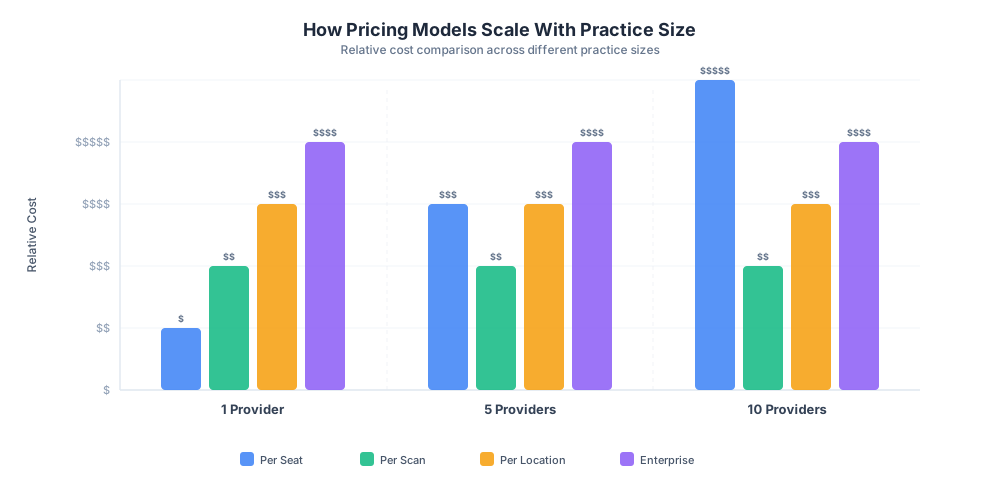
How the four main dental AI pricing models scale with practice size. Per-seat costs increase linearly; per-scan and per-location remain relatively stable.
Four models are in play. The model matters more than the monthly number because it determines how your costs scale as your practice grows, how predictable your expenses are, and which scenarios create surprise bills.
1. Per provider seat
You pay a fixed monthly or annual fee for each provider (dentist or hygienist) who uses the AI tool. A two-dentist practice pays twice what a solo practice pays. Adding a third dentist adds a third seat fee.
Who this favors: Solo practices and small practices with stable provider counts. Your cost is fixed and predictable month to month. You know exactly what the AI line item is on your P&L.
Who this hurts: Growing practices. Every new associate hire increases your AI cost. Practices with part-time providers may be paying full seat fees for providers who work two days a week. Ask whether part-time providers are billed at the same rate.
2. Per scan / per image
You pay based on the volume of radiographs processed by the AI. More images, higher bill. Some vendors set volume tiers: the first 500 scans per month at one rate, the next 500 at a lower rate.
Who this favors: Low-volume practices. If you are a solo practitioner seeing 8-10 patients a day and taking radiographs on a fraction of them, your per-scan costs may be modest. You pay for what you use.
Who this hurts: High-volume practices and any practice that takes full-mouth series, panoramic radiographs, or imaging on every recall visit. The math can get ugly fast. A busy practice taking 150+ radiographs per day could see per-scan pricing exceed what a flat-rate plan would cost. Also watch for “per image” vs “per series” definitions. A full-mouth series of 18 images could be counted as 1 series or 18 images depending on how the vendor defines the unit.
3. Per location
You pay a flat monthly or annual fee per physical practice location. Every provider at that location can use the tool. The number of providers and the number of scans do not affect the price (within whatever fair-use limits the contract specifies).
Who this favors: Multi-provider practices at a single location. A four-dentist practice with three hygienists pays the same as a solo practice in the same building. If you are adding providers, your AI cost does not change. This model rewards density.
Who this hurts: Multi-location groups that are location-light. If you run five locations with one dentist each, you are paying five location fees. The per-provider model might be cheaper in that scenario. Also, “per location” can get complicated with mobile practices, satellite offices, or practices that share space.
4. Enterprise flat rate
A negotiated annual fee covering your entire organization. Common for DSOs (dental service organizations) with 50+ locations. The rate is custom and based on total organization size, volume, and contract length.
Who this favors: Large DSOs with the negotiating leverage to get volume discounts and the operational infrastructure to deploy across all locations simultaneously.
Who this hurts: Nobody directly, but the enterprise sales cycle is long (3-6 months), requires executive buy-in, and the contracts often come with multi-year commitments that are difficult to exit.
How much does Overjet cost?
Overjet does not publish prices; it quotes after a demo.
What is publicly known: Overjet has been described in practitioner discussions and industry reporting as using a per-provider pricing model. Multiple Dentaltown threads and industry reports reference a per-provider monthly fee, though the specific dollar amounts vary across sources and time periods and we cannot verify current rates.
What per-provider means for an Overjet evaluation:
For a solo practice, the calculation is straightforward: one seat, one fee, every month. For a two-dentist, three-hygienist practice, you need to clarify whether hygienists count as “providers” for pricing purposes. If Overjet’s primary value proposition is the bone level measurement for perio, and your hygienists are the ones reviewing that data during initial periodontal screenings, do hygienists need their own seats? Or do they access findings through the dentist’s account? These are questions for the sales call.
Overjet also has enterprise agreements with several large DSOs, including a widely reported partnership with Heartland Dental. Enterprise pricing at that scale is a different conversation entirely: negotiated rates, multi-year terms, and deployment support that a solo practice will never see.
Unverified pricing references: Forum posts from 2024 and 2025 mention monthly per-provider fees in ranges that vary enough across sources that publishing a specific number would be irresponsible. The only reliable number is the one you get on your sales call for your specific practice configuration.
How much does Pearl cost?
Pearl does not publish prices; it quotes after a demo.
What is publicly known: Pearl has been described in industry reporting and vendor presentations as using a per-location pricing model. The Practice Intelligence product (analytics dashboard for practice performance metrics) may be priced as a separate module on top of the core Second Opinion detection product.
What per-location means for a Pearl evaluation:
A per-location model is attractive if you have multiple providers at a single location. A practice with three dentists and four hygienists pays the same location fee as the solo practitioner next door. If you are adding an associate next year, your AI cost does not change. This model incentivizes Pearl to support as many users per location as possible, which aligns the vendor’s interests with the practice’s growth.
For multi-location practices, the math changes. Three locations means three location fees, regardless of whether location #3 has one dentist or four. If you are a small group with a few satellite offices that operate two days a week, you may be paying full location fees for part-time operations. Ask whether there is a distinction between full-time and part-time locations.
Pearl’s Patterson partnership (announced July 2024) for Eaglesoft integration may affect pricing for Eaglesoft practices. Patterson may bundle or discount the AI component as part of a broader technology package. If you are a Patterson/Eaglesoft practice, ask Patterson about bundled pricing before going directly to Pearl.
Practice Intelligence as a separate module: If the analytics dashboard is priced separately, calculate the total cost of the detection product plus the analytics product. The analytics module may provide the data you need for ROI tracking, but it is an additional line item.
How much does VideaHealth cost?
VideaHealth does not publish prices; it quotes after a demo.
What is publicly known: VideaHealth has focused heavily on the DSO and enterprise market. Their partnership with Henry Schein to power Detect AI (the AI imaging feature inside Dentrix) is the primary distribution channel for independent practices. This means the pricing for independent practices may come through Henry Schein/Dentrix rather than directly from VideaHealth.
What this means for an evaluation:
If you are on Dentrix: the Detect AI feature may be available as an add-on through your existing Dentrix relationship. Pricing through the Henry Schein channel may be structured differently than a direct VideaHealth contract, potentially as part of a Dentrix subscription tier or as a monthly add-on. Contact your Henry Schein rep for current pricing and terms.
If you are not on Dentrix: VideaHealth’s confirmed integrations include Eaglesoft and Open Dental in addition to Dentrix, but the primary go-to-market for independent practices has been through the Dentrix/Henry Schein channel. Direct VideaHealth contracts are available but may be oriented more toward group practices and DSOs.
DSO pricing: VideaHealth’s DSO agreements are enterprise-level and negotiated individually. Published case studies reference deployments across hundreds of locations, suggesting volume-based pricing that is not comparable to independent practice rates.
What costs sit outside the subscription?
The subscription fee is the line item you see. The costs below are the line items you discover after signing.
Implementation and training fees. Some vendors charge a one-time setup fee for installation, configuration, and initial staff training. Others include it in the first year’s subscription. Ask whether implementation is included or billed separately, and whether additional training sessions after the initial rollout cost extra.
Minimum contract length. Month-to-month contracts are rare in this category. Annual contracts are common. Multi-year contracts (2-3 years) may come with lower monthly rates but lock you in. Ask what the cancellation clause looks like. If you are unhappy at month four of a 24-month contract, what are your options?
WARNING
‘Unlimited’ Rarely Means Unlimited
If a vendor says “unlimited scans” under a flat-rate plan, check the contract for a fair-use clause or volume cap. “Unlimited” in a SaaS contract almost always means “the amount of usage we expect from a typical practice, beyond which we reserve the right to renegotiate.” Get the cap in writing before you sign.
PMS integration fees. Some integrations may require an additional module purchase from either the AI vendor or the PMS vendor. If the AI tool integrates with Dentrix, does Dentrix charge an additional fee to enable the integration on their end? This is a common gotcha with third-party integrations.
Software update costs. As the AI vendor obtains additional FDA clearances and adds new detection capabilities, are those updates included in your existing subscription or priced as add-ons? If Overjet adds a new pathology detection module next year, do you get it automatically or pay a new fee?
Hardware requirements. Most dental AI imaging tools are cloud-based, but some may require specific workstation specifications, dedicated monitors for display, or minimum internet bandwidth for real-time processing. If your operatory workstations are older machines, factor in potential hardware upgrades.
Price escalation clauses. Does the contract allow annual price increases? If so, is there a cap? A 3% annual escalator on a $500/month subscription means you are paying $530 in year two, $546 in year three, and $579 in year five. That is a 16% increase over the contract life. Find the escalation clause and read it.
What would a three-provider practice pay?
A worked example, using published prices where they exist.
The practice: 3 providers (2 dentists, 1 hygienist), single location, approximately 40 patients per day, roughly 80-100 radiographic images per day across all patients.
What the published prices come to for this practice:
- Better Diagnostics in Open Dental: one location fee, $149 a month or $1,788 a year, whatever the provider count. Only an option if you run Open Dental.
- Denti.AI OneStop Clinical: $3,990 a year billed annually, or $399 a month month to month, with AI notes and voice perio in the same plan.
- Diagnocat 2D Lite: €499 a year for 1,500 2D reports, about 125 a month. Check how many FMX and panoramic studies you take before assuming that covers you; unused reports expire.
For vendors that quote, the model decides the bill:
- Per provider: three seats if hygienists count, two if they don’t. The number of images does not change the cost.
- Per location: one fee whether you have two providers or five, until you open a second office.
- Per scan: 80-100 images a day is 1,600-2,000 a month. This rewards low-volume practices and punishes practices that take FMX series routinely. Ask whether an 18-image FMX counts as one unit or eighteen.
The cheapest vendor is not the one with the lowest headline rate. It is the one whose pricing model matches how your practice grows and how many images you take.
ROI claims vs. reality
Every dental AI vendor will present an ROI model during the sales process. The standard claims include:
- Increased case acceptance. “Patients who see the AI overlay accept treatment at higher rates.” This is plausible. Visual aids have been shown to improve case acceptance in dentistry generally, but the magnitude of the effect specifically from AI overlays vs. other visual tools (intraoral cameras, existing digital imaging) has limited independent study.
- Reduced missed diagnoses. “The AI catches things you miss.” Also plausible. Any second look at a radiograph, human or algorithmic, has a chance of catching something the first reviewer missed. But the clinical significance of the additional findings matters: is the AI catching incipient lesions that you would have watched and monitored anyway, or is it catching active pathology that would have gone untreated?
- Revenue uplift. Vendors may cite numbers like “practices see a $20-50 per patient increase in treatment value.” These figures typically come from internal vendor studies or early-adopter case studies, not independent research. The practices that adopt AI early may be systematically different from the average practice: more technology-forward, more proactive on treatment planning, higher baseline case acceptance. Attributing revenue changes solely to the AI tool without controlling for those differences is a common statistical error.
What would constitute real evidence: A prospective study where matched practices (same specialty, same patient demographics, same geographic market) are randomized to AI-assisted or standard workflow, with blinded outcome measurement over 12+ months. As of this writing, we are not aware of such a study being published for any dental AI imaging tool. That does not mean the tools don’t work. It means the evidence for ROI specifically is not at the level where you should accept vendor claims at face value.
The honest calculation: Track your own numbers. Before deploying the tool, document your current case acceptance rate, treatment value per patient, and missed-diagnosis callbacks over a 3-month period. After deploying, measure the same metrics for 6 months. The difference, controlling for seasonal variation and other workflow changes, is your ROI. The vendor’s ROI model is a sales tool. Your own data is evidence.
TIP
Build Your Own ROI Baseline
Before deploying any AI imaging tool, document three metrics over a 3-month period: case acceptance rate, treatment value per patient, and missed-diagnosis callbacks. After 6 months with the tool, measure the same metrics. That comparison, not the vendor’s model, is your actual ROI.
Ten questions to ask on the sales call
For every vendor except the three with published prices, the sales call is the only way to get a number. Make it productive by asking questions that reveal contract structure, not just features. Print this list or have it on your screen during the call.
- What is the pricing model: per provider, per scan, per location, or flat rate? Get the exact model. If it is per provider, ask whether hygienists count. If per scan, ask whether a full-mouth series counts as one scan or eighteen.
- What is the minimum contract length? Month-to-month, annual, or multi-year? What discount, if any, do you get for a longer commitment?
- What are the cancellation terms? If you want to cancel at month eight of an annual contract, what happens? Early termination fee? Are remaining months due? Can you cancel at renewal without penalty?
- Is there a price escalation clause? Can the vendor raise the price at renewal? Is there a cap? Annual CPI adjustment or uncapped?
- What is included in the base subscription and what costs extra? Implementation? Training? Additional training sessions after launch? Software updates? New detection modules from future FDA clearances? Analytics dashboards?
- Are there volume caps on “unlimited” plans? If the pricing is flat-rate, is there a fair-use policy? What happens if you exceed it?
- What does the implementation timeline look like? From signed contract to fully operational in the operatory, how many weeks? What is required from your team during implementation? How much staff time?
- Can you do a pilot before committing to a full contract? How long is the pilot? What does the pilot cost, if anything? Does the pilot period count toward the contract length?
- What PMS integrations are live today, not “coming soon”? Specifically for your PMS. Not “we integrate with all major platforms.” Have them show you the integration working on your specific PMS version. “Coming soon” is not a feature.
- Can you connect me with three practices similar to mine that are currently using the tool? Not early adopters or showcase practices. Practices of similar size, in a similar market, that have been live for at least six months. If the vendor cannot provide references, that is information.
What this guide cannot tell you
We cannot tell you what Overjet, Pearl, or VideaHealth costs for your practice today. Before you get to pricing, make sure you understand what each tool is actually cleared by the FDA to do, and if you are deciding between Overjet and Pearl specifically, our side-by-side comparison of their clearance letters covers the clinical differences. The pricing changes, the models evolve, the negotiated rates vary by region and volume and competitive situation. A vendor may offer you a different rate than the practice down the street based on factors neither of you will ever see.
We list only prices a vendor publishes on its own site, with the page and the date we checked it. We did not ask vendors for quotes: a quote reflects one practice’s size, region and negotiating position, and rate cards change without notice. For quoted vendors, the value of this guide is the framework: understand the models, know the hidden costs, ask the right questions.
Pricing in dental AI will change. It will likely come down as competition increases, as the tools become table-stakes rather than differentiators, and as PMS platforms build or acquire their own AI capabilities. The practice that signs a 3-year contract today at 2026 rates may be overpaying relative to 2028 market rates. Factor contract flexibility into your evaluation alongside the monthly fee.
The most expensive dental AI tool is the one you pay for and do not use. Before worrying about whether per-provider or per-location is cheaper, answer the prior question: do you have a defined clinical workflow for how AI findings will be reviewed, presented, and acted on in your practice? If the answer is no, the pricing model is irrelevant. Fix the workflow first. Then shop for the tool. When you are ready to shop, our 2026 buyers guide covers the full landscape of dental AI tools beyond imaging.
Frequently asked questions
How much does dental AI x-ray software cost?
Published prices start at $149 per location per month (Better Diagnostics inside Open Dental). Denti.AI is $399 per location per month, or $333 billed annually, including AI notes and voice perio. Diagnocat's self-serve plans start at €499 a year for 2D reports and €990 a year with CBCT. Overjet, Pearl and VideaHealth quote after a demo (checked October 2026).
How much does Overjet cost?
Overjet does not publish prices; it quotes after a demo. Practitioner forums describe per-provider monthly pricing, but we could not verify current rates. Ask whether hygienists count as providers and what the contract length and escalator are.
How much does Pearl dental AI cost?
Pearl does not publish prices; it quotes after a demo. Industry reporting describes per-location pricing, with Practice Intelligence analytics possibly priced as a separate module. Confirm both on the sales call.
Which dental AI tools publish their prices?
Of the FDA-cleared imaging tools we track, three: Better Diagnostics ($149 per location per month via Open Dental), Denti.AI ($399 per location per month, $333 billed annually) and Diagnocat (from €499 a year). Prices from each vendor's pricing page, October 2026.
Sources
Independent. We verify regulatory claims against the FDA 510(k) database and link every filing. Found an error? Email [email protected]; corrections are logged on our editorial policy page.