Claude Prompts for Dental Referral Letters: 7 Templates Tested Against Real Specialist Expectations
We tested 7 Claude prompts for dental referral letters across 5 specialty types. The AI drafts are structurally sound and save 5-10 minutes per letter, but every output needs a clinician to fill in patient-specific findings before sending. Here are the prompts, outputs, and a breakdown of what to include vs. omit.

General dentists write a lot of referral letters. A practice that handles 20-30 patients a day will generate several specialist referrals per week: to oral surgeons for impacted thirds, to endodontists for complex retreatments, to periodontists for advanced bone loss, to orthodontists for malocclusion consults, and to pediatric dentists for patients who need a child-focused environment. Each letter follows a predictable structure: patient demographics, clinical findings, reason for referral, relevant history, and radiographic notes. The content matters (a vague referral wastes the specialist’s time and delays care), but the structure is repetitive enough that AI can produce a solid first draft.
We wrote 7 prompts covering the most common referral scenarios and ran each through Claude (claude-sonnet-4-6). Below are the exact prompts, the unedited outputs for 5 of them, and practical notes on what clinical details to include, what to leave out, and how to handle HIPAA when using AI tools for patient-identifiable correspondence.
What Clinical Details to Include vs. Omit in AI-Drafted Referrals
Before the prompts, a practical framework. Specialist referral letters need specific clinical information to be useful, but the prompt you give to an AI model should not contain real patient data unless you have addressed HIPAA requirements first (see the HIPAA section below).
Include in the prompt as placeholders:
- Patient age and gender (relevant to treatment planning)
- Tooth numbers using universal numbering
- Chief complaint and symptom duration
- Relevant medical history flags (e.g., bisphosphonate use, bleeding disorders, diabetes)
- Radiographic findings (periapical radiolucency, bone loss measurements, impaction classification)
- Treatment already attempted
- Urgency level
Omit from the prompt (fill in manually after):
- Patient full name, date of birth, or contact information
- Insurance details
- Social Security or ID numbers
- Any information that would make the letter identifiable before you are ready to send it through a HIPAA-compliant channel
The AI produces the letter structure and professional language. You fill in the clinical specifics from the patient chart.
Prompt 1: Oral Surgery Referral (Impacted Third Molars)
The prompt:
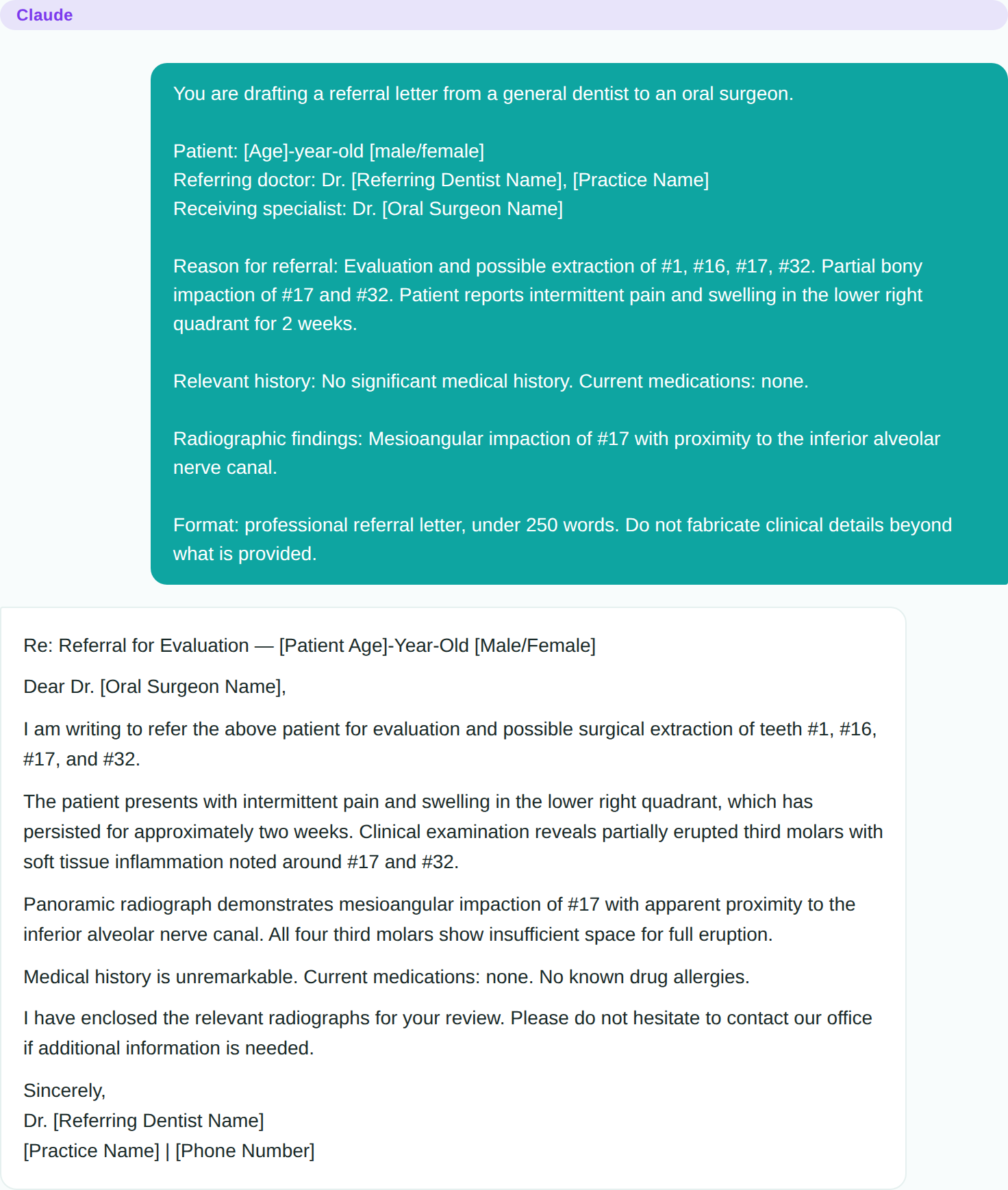
You are drafting a referral letter from a general dentist to an oral surgeon.

Patient: [Age]-year-old [male/female]
Referring doctor: Dr. [Referring Dentist Name], [Practice Name]
Receiving specialist: Dr. [Oral Surgeon Name] or "To Whom It May Concern"

Reason for referral: Evaluation and possible extraction of [tooth numbers, e.g., #1, #16, #17, #32]. [Impaction classification if known, e.g., partial bony impaction of #17 and #32]. Patient reports [symptoms if any, e.g., intermittent pain and swelling in the lower right quadrant for 2 weeks].

Relevant history: [Medical history flags, e.g., no significant medical history / patient takes blood thinners / history of dry socket]. Current medications: [list or "none"].

Radiographic findings: [Describe what the panoramic or periapical shows, e.g., mesioangular impaction of #17 with proximity to the inferior alveolar nerve canal].

Format: professional referral letter, under 250 words. Include a line for the referring dentist's signature.
Do not fabricate clinical details beyond what is provided.
The output:
Dr. [Oral Surgeon Name] [Oral Surgery Practice Name] [Address]
Re: Referral for Evaluation, [Patient Age]-Year-Old [Male/Female]
Dear Dr. [Oral Surgeon Name],
I am writing to refer the above patient for evaluation and possible surgical extraction of teeth #1, #16, #17, and #32.
The patient presents with intermittent pain and swelling in the lower right quadrant, which has persisted for approximately two weeks. Clinical examination reveals partially erupted third molars with soft tissue inflammation noted around #17 and #32.
Panoramic radiograph demonstrates mesioangular impaction of #17 with apparent proximity to the inferior alveolar nerve canal. All four third molars show insufficient space for full eruption.
Medical history is [unremarkable / significant for the following: list]. Current medications: [list or none]. No known drug allergies.
I have enclosed the relevant radiographs for your review. Please do not hesitate to contact our office if additional information is needed.
Thank you for seeing this patient. I look forward to your evaluation and recommendations.
Sincerely,
Dr. [Referring Dentist Name] [Practice Name] [Phone Number] [Fax/Email]
Assessment: The structure matches what oral surgery offices expect to receive. The AI correctly preserved the placeholder format rather than inventing clinical details. The IAN proximity note is clinically relevant; oral surgeons specifically want this flagged. A referring dentist would need to attach actual radiographs and fill in the patient specifics, but the letter itself is ready after that.
Prompt 2: Endodontic Referral (Complex Root Canal)
The prompt:
You are drafting a referral letter from a general dentist to an endodontist.

Patient: [Age]-year-old [male/female]
Referring doctor: Dr. [Referring Dentist Name], [Practice Name]
Receiving specialist: Dr. [Endodontist Name]

Reason for referral: Endodontic evaluation of [tooth number]. [Describe the situation, e.g., Tooth #19 has a periapical radiolucency measuring approximately 4mm, patient reports spontaneous throbbing pain, and cold testing shows lingering response. Calcified canals noted on radiograph, referring due to complexity.]

Previous treatment: [e.g., large MOD composite placed 3 years ago / previous pulp cap / no prior endo treatment].

Medical history: [flags or "unremarkable"]. Medications: [list or "none"].

Format: professional referral letter, under 250 words.
Do not fabricate clinical details beyond what is provided.
The output:
Dr. [Endodontist Name] [Endodontic Practice Name] [Address]
Re: Endodontic Referral, [Patient Age]-Year-Old [Male/Female], Tooth #19
Dear Dr. [Endodontist Name],
I am referring this patient for endodontic evaluation and likely treatment of tooth #19.
The patient presents with spontaneous throbbing pain localized to the lower left quadrant. Cold testing on #19 elicits a lingering response. Periapical radiograph reveals a radiolucency measuring approximately 4mm at the apex of #19. The tooth has a large MOD composite restoration placed approximately three years ago.
Radiographic review suggests calcified canals, which is the primary reason I am referring rather than treating in-house. No prior endodontic treatment has been attempted on this tooth.
Medical history is [unremarkable / as noted]. Current medications: [list or none]. No known drug allergies.
Periapical radiographs are enclosed. Please contact our office if you require additional imaging or clinical information.
Thank you for your care of this patient.
Sincerely,
Dr. [Referring Dentist Name] [Practice Name] [Phone Number]
Assessment: Endodontists value specific diagnostic test results (cold, percussion, EPT) and the reason the GP isn’t treating in-house. This output includes both. The “calcified canals” rationale for referral is exactly the kind of detail that helps the endodontist prepare before the patient arrives. Structurally solid.
Prompt 3: Periodontal Referral (Advanced Bone Loss)
The prompt:
You are drafting a referral letter from a general dentist to a periodontist.

Patient: [Age]-year-old [male/female]
Referring doctor: Dr. [Referring Dentist Name], [Practice Name]
Receiving specialist: Dr. [Periodontist Name]

Reason for referral: Periodontal evaluation and treatment planning. [Describe findings, e.g., Generalized Stage III, Grade B periodontitis. Probing depths of 6-8mm in the posterior sextants. Radiographic bone loss of 30-50% around #3, #14, #19, and #30. Patient completed SRP 6 weeks ago with limited improvement. Referring for possible surgical intervention.]

Relevant history: [e.g., Patient is a current smoker, 10 pack-year history. Type 2 diabetes, A1c of 7.8. Takes metformin 1000mg BID.]

Format: professional referral letter, under 250 words.
Do not fabricate clinical details beyond what is provided.
The output:
Dr. [Periodontist Name] [Periodontal Practice Name] [Address]
Re: Periodontal Referral, [Patient Age]-Year-Old [Male/Female]
Dear Dr. [Periodontist Name],
I am referring this patient for periodontal evaluation and treatment planning following limited response to initial therapy.
Clinical findings are consistent with generalized Stage III, Grade B periodontitis. Probing depths range from 6-8mm in the posterior sextants, with radiographic evidence of 30-50% horizontal bone loss around teeth #3, #14, #19, and #30. The patient completed scaling and root planing six weeks ago. Re-evaluation shows persistent probing depths with minimal improvement, and I am referring for evaluation of possible surgical intervention.
Pertinent medical history includes Type 2 diabetes with a most recent A1c of 7.8, managed with metformin 1000mg twice daily. The patient is a current smoker with an approximately 10 pack-year history.
Full-mouth probing chart, current radiographic series, and periodontal charting are enclosed.
Please let me know your findings and recommendations. I am happy to coordinate any restorative treatment once periodontal stability is established.
Sincerely,
Dr. [Referring Dentist Name] [Practice Name] [Phone Number]
Assessment: The staging/grading classification, specific probing depths, bone loss percentages, and the note that SRP was already attempted are exactly what a periodontist needs to triage the case before the first appointment. The medical history section correctly highlights diabetes control and smoking status, both of which directly affect periodontal treatment planning and prognosis. The closing line about coordinating restorative work signals good interdisciplinary communication.
Prompt 4: Orthodontic Referral (Malocclusion Evaluation)
The prompt:
You are drafting a referral letter from a general dentist to an orthodontist.

Patient: [Age]-year-old [male/female]
Referring doctor: Dr. [Referring Dentist Name], [Practice Name]
Receiving specialist: Dr. [Orthodontist Name]

Reason for referral: Orthodontic evaluation for [describe, e.g., Class II Division 1 malocclusion with 8mm overjet, moderate crowding in the lower anterior region, and a posterior crossbite on the left side. Patient is interested in treatment options.]

Dental history: [e.g., All permanent teeth present. No prior orthodontic treatment. Oral hygiene is good. Caries-free at last exam.]

Medical history: [flags or "unremarkable"].

Format: professional referral letter, under 200 words.
Do not fabricate clinical details beyond what is provided.
This prompt produces a clean referral noting the classification, overjet measurement, crowding description, and crossbite, the key data points an orthodontist needs for initial assessment. The output follows the same structure as the letters above: header, clinical summary, relevant history, enclosed records, and signature block.
Prompt 5: Pediatric Dentistry Referral (Behavioral Management)
The prompt:
You are drafting a referral letter from a general dentist to a pediatric dentist.

Patient: [Age]-year-old [male/female]
Referring doctor: Dr. [Referring Dentist Name], [Practice Name]
Receiving specialist: Dr. [Pediatric Dentist Name]

Reason for referral: [Describe, e.g., 4-year-old male requires treatment for carious primary teeth (#A, #B, #J, #K) but is unable to cooperate for treatment in our office. Two attempts at restorative treatment were unsuccessful due to behavioral management challenges. Referring for evaluation under sedation or general anesthesia.]

Medical history: [e.g., No significant medical history. Up to date on immunizations. No known allergies.]

Format: professional referral letter, under 200 words.
Do not fabricate clinical details beyond what is provided.
This prompt produces a referral that clearly documents the failed in-office attempts (important for insurance pre-authorization of sedation/GA) and identifies the specific teeth requiring treatment. Pediatric dentists report that the most useful referrals include the number of prior attempts and the specific behavioral challenges encountered.
Prompt 6: Oral Surgery Referral (Biopsy of Suspicious Lesion)
The prompt:
You are drafting a referral letter from a general dentist to an oral surgeon.

Patient: [Age]-year-old [male/female]
Referring doctor: Dr. [Referring Dentist Name], [Practice Name]
Receiving specialist: Dr. [Oral Surgeon Name]

Reason for referral: Evaluation and possible biopsy of [describe lesion, e.g., a persistent white patch on the left lateral border of the tongue, approximately 1.5cm x 1cm, present for more than 3 weeks with no resolution. Non-tender. No history of trauma to the area. Patient is a former smoker.]

Format: professional referral letter, under 200 words. Convey appropriate urgency without alarming the patient if they see the letter.
Do not fabricate clinical details beyond what is provided.
This prompt handles the sensitive balance of flagging a potentially concerning lesion while keeping the letter professional and non-alarmist. The output includes lesion dimensions, duration, location, and relevant risk factors, all of which help the oral surgeon prioritize scheduling.
Prompt 7: Endodontic Referral (Retreatment After Failed Root Canal)
The prompt:
You are drafting a referral letter from a general dentist to an endodontist.

Patient: [Age]-year-old [male/female]
Referring doctor: Dr. [Referring Dentist Name], [Practice Name]
Receiving specialist: Dr. [Endodontist Name]

Reason for referral: Endodontic retreatment evaluation for [tooth number]. [Describe, e.g., Tooth #30 had root canal treatment completed approximately 2 years ago. Patient now presents with recurrent pain and a periapical radiolucency that was not present on prior films. Current restoration is a PFM crown. Referring for evaluation of retreatment vs. apicoectomy.]

Medical history: [flags or "unremarkable"].

Format: professional referral letter, under 250 words.
Do not fabricate clinical details beyond what is provided.
This produces a letter that documents the original treatment timeline, current symptoms, radiographic changes since the initial treatment, and the existing restoration, all critical for the endodontist to plan their approach and discuss options with the patient.
HIPAA Considerations When Using AI for Referral Letters
This is the section that matters most for real-world use. Using Claude or any AI tool to draft referral letters creates HIPAA exposure if you include protected health information (PHI) in the prompt.
The core issue: When you type a patient’s name, date of birth, diagnosis, or any of the 18 HIPAA identifiers into a consumer AI interface (claude.ai, chatgpt.com), that data is transmitted to the AI provider’s servers. Under HIPAA, this constitutes a disclosure of PHI to a third party. Without a Business Associate Agreement (BAA) between your practice and the AI provider, this disclosure violates the HIPAA Privacy Rule.
Practical approach for dental practices:
-
Use placeholders, not real patient data. Every prompt above uses brackets: [Patient Age], [Tooth Number], [Practice Name]. Draft the letter with placeholders, then fill in patient specifics from the chart after the AI produces the output. The AI never sees PHI.
-
If you need the AI to process real patient data, you need a HIPAA-compliant deployment. Anthropic offers a HIPAA-eligible API with BAA availability for organizations processing PHI through Claude. The consumer web interface at claude.ai is not covered by a BAA and should not be used for identifiable patient information.
-
De-identify before prompting. If you want the AI to work with actual clinical details (e.g., complex medical histories), remove all 18 HIPAA identifiers first. Use “55-year-old female” instead of the patient’s name and birthdate. Use tooth numbers instead of anything traceable.
-
Document your workflow. If your practice uses AI for any patient communication, your HIPAA policies and procedures manual should include a section describing the workflow, who approved it, and what safeguards are in place. This matters during an audit.
Tips for Getting Better Referral Letter Drafts
Be specific about the specialist type. “Referral to an oral surgeon” produces different language than “referral to a periodontist.” The AI adjusts terminology, the information it emphasizes, and the level of detail based on what the receiving specialty typically wants to see.
Include your diagnostic test results. Endodontic referrals improve significantly when you add cold test, percussion, EPT, and probing results to the prompt. Periodontal referrals improve with probing depths and staging. The AI can structure these findings into professional language, but only if you provide them.
Specify the format constraints. “Under 250 words” keeps the output focused. Without a word limit, Claude tends to produce letters that are longer than most specialists want to read.
State what you’ve already tried. “Patient completed SRP 6 weeks ago with limited improvement” or “Two attempts at restorative treatment were unsuccessful.” This context helps both the AI draft and the specialist receiving the letter.
Honest Limitations
These prompts produce structurally sound referral letters that follow professional conventions. They save time on the repetitive formatting and language that makes up 70-80% of every referral letter. But no AI-drafted referral letter is ready to send without clinician review. The same workflow (AI drafts the structure, clinician verifies the clinical content) applies to insurance pre-authorization narratives and appeal letters, where the prompt library covers crowns, root canals, implants, perio, and denied claims.
The AI cannot verify that the clinical information you provided is complete or accurate. It cannot look at a radiograph and describe what it sees. It cannot decide whether a referral is clinically appropriate. It produces the container; you provide and verify the clinical content.
For practices writing 5 or more referral letters per week, the time savings are meaningful. For the occasional referral, the value is mainly in having a professional template that covers all the sections a specialist expects to see.