- AI drafts follow the standard narrative structure and use medical necessity language, but clinical specifics need checking
- Always verify findings, CDT codes, and diagnostic terminology against the chart
- The clinician who examined the patient must review the narrative before submission, not the office manager
- Appeal letters are a natural fit for AI drafting because they are structured argumentation
- Use a three-step workflow: clinician documents, AI drafts, clinician reviews
Insurance narratives are the dental equivalent of TPS reports. They’re necessary, formulaic, and soul-crushingly repetitive. Every crown needs a narrative justifying medical necessity. Every root canal needs documentation. Every implant needs pre-authorization with supporting clinical findings. The language is specific, the structure is predictable, and the consequences of getting it wrong are real. A badly written narrative doesn’t just get denied; it delays treatment and frustrates patients who thought their insurance would cover it.
This is where AI should excel. Insurance narratives follow a rigid pattern: clinical findings, diagnosis, proposed treatment, rationale for medical necessity. The vocabulary is standardized. The structure barely varies. It’s exactly the kind of repetitive professional writing that large language models were built for.
A model can usually produce the right structure, clinical-sounding terminology, and medical necessity language. Where it falls short is clinical specifics. It can state findings that weren’t in your prompt, imply diagnoses you didn’t make, or use CDT code language that doesn’t match the actual procedure. These are the kinds of errors that get claims flagged, and they’re subtle enough that a tired office manager might miss them on a busy Friday afternoon.
NOTE
About the example outputs
The example outputs were generated with Claude (claude-sonnet-4-6) through its web interface and are shown unedited. AI output varies from run to run and must be reviewed by your practice before use. The narratives were not reviewed by a clinician or a dental insurance specialist, and none were submitted to an insurance company. Requirements vary by carrier, plan type, and region.
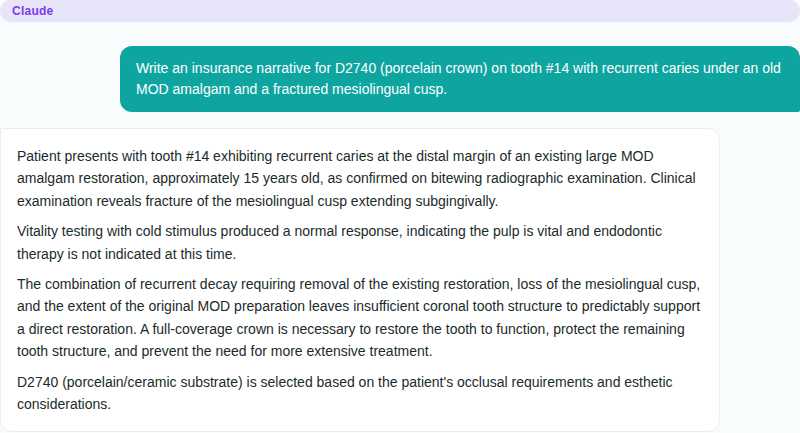
Example output from Claude for a porcelain crown narrative (D2740), unedited. Prompt 1.
Dental Insurance Narrative Template
A dental insurance narrative is a short statement that tells the carrier’s reviewer why a procedure is needed for this patient and this tooth. Most follow four parts: clinical findings, diagnosis, the proposed treatment with its CDT code, and why that treatment rather than a less costly alternative.
The fill-in template below uses that structure. Replace every bracket with a finding from the chart, and delete any line you cannot support with a measurement, test result or image.
Patient: [Name], DOB [date]. Member ID: [ID]
Procedure: [CDT code and descriptor]. Tooth/area: [tooth # or quadrants]

Findings: On [exam date], clinical examination showed [measured findings,
e.g. probing depths, fracture location, vitality test result, mobility].
[Radiograph type and date] shows [radiographic findings].

Diagnosis: [diagnosis, with classification where one applies].

Rationale: [Procedure] is indicated because [link each finding to the need].
[Less costly alternative] is not adequate because [reason tied to a finding].
Without treatment, [expected consequence for this tooth or area].

Enclosed: [radiographs, periodontal chart, intraoral photographs].
Provider: [Name, credentials], NPI [number]
For a crown, the alternative to address is a direct restoration (see Prompt 1). For a buildup, state why it replaces missing structure rather than forming part of the crown prep (Prompt 5). For adult orthodontics, the rationale needs functional problems beyond appearance (Prompt 7).
SRP Narrative Template (D4341)
An SRP narrative should give probing depths by quadrant, bleeding on probing, radiographic bone loss, subgingival calculus, the periodontal diagnosis, and why a prophylaxis is not enough. It goes with the radiographs and perio chart; it does not replace them.
Carrier rules differ, so check the patient’s plan. As one published example, Envolve Dental’s non-surgical periodontics policy (ENVD.UM.CP.0006, last reviewed November 2021) asks for:
- Full-mouth radiographs with bitewings taken within the last 6 months. A panoramic image is not accepted as a substitute.
- Periodontal pocket depth charting from the last 6 months.
- Chart notes explaining the reason when more than two quadrants of SRP are done on the same date of service.
The same policy limits D4341 or D4342 to one per quadrant per 24 months, subject to state rules, and lists gingivitis without attachment loss as a contraindication. D4341 is SRP for four or more teeth per quadrant; D4342 is for one to three teeth.
Procedure: D4341, periodontal scaling and root planing, four or more teeth
per quadrant. Quadrants: [UR, UL, LR, LL]. Planned dates: [dates]

Findings ([exam date]): Probing depths of [range] mm with bleeding on probing
in [quadrants]; [number] teeth per quadrant with pockets of [X] mm or more.
Clinical attachment loss of [range] mm. [Light/moderate/heavy] subgingival
calculus on exploration. Full-mouth series dated [date] shows [generalized/
localized] [horizontal/vertical] bone loss of [extent]. Mobility: [findings].

Diagnosis: Periodontitis, Stage [ ], Grade [ ], [localized/generalized]
(2017 AAP/EFP classification).

Rationale: A prophylaxis (D1110) is not adequate because [findings, e.g.
X mm pockets with attachment loss and radiographic bone loss]. Scaling and
root planing is indicated to [treatment goal]. [If more than two quadrants
on one date: reason.] Re-evaluation is planned [interval] after treatment.

Enclosed: full-mouth radiographs with bitewings ([date]), periodontal chart
([date]).
For an unedited AI-written SRP narrative example and the coding errors to look for, see Prompt 4. Prompt 8 shows an SRP narrative combined with a phased restorative plan.
Prompt 1: Crown Narrative (D2740, Porcelain/Ceramic, Molar)
The scenario: a patient needs a crown on tooth #14 (upper left first molar). There’s an existing large amalgam restoration with recurrent decay, and the mesiolingual cusp is fractured. You need a narrative for the pre-authorization.
The prompt:
You are writing an insurance pre-authorization narrative for a dental procedure.

Patient: [Patient Name], DOB [Date of Birth]
Provider: Dr. Sarah Chen, DDS
Practice: Maple Street Dental

Procedure: D2740, Crown, porcelain/ceramic substrate
Tooth: #14 (upper left first molar)

Clinical findings:
- Existing large MOD amalgam restoration, approximately 15 years old
- Recurrent decay at the distal margin of the existing restoration, confirmed on bitewing radiograph
- Fracture of the mesiolingual cusp extending below the gingival margin
- Tooth is vital, responding normally to cold test
- Insufficient remaining tooth structure to support a direct restoration

Diagnosis: Recurrent caries with cusp fracture on previously restored tooth

Write a pre-authorization narrative supporting medical necessity for a porcelain/ceramic crown. Use standard insurance narrative structure: clinical findings, diagnosis, rationale for crown vs. direct restoration. Keep it under 200 words. Use clinical terminology appropriate for insurance reviewers.
The output:
Patient presents with tooth #14 exhibiting recurrent caries at the distal margin of an existing large MOD amalgam restoration, approximately 15 years old, as confirmed on bitewing radiographic examination. Clinical examination reveals fracture of the mesiolingual cusp extending subgingivally.
Vitality testing with cold stimulus produced a normal response, indicating the pulp is vital and endodontic therapy is not indicated at this time.
The combination of recurrent decay requiring removal of the existing restoration, loss of the mesiolingual cusp, and the extent of the original MOD preparation leaves insufficient coronal tooth structure to predictably support a direct restoration (composite or amalgam). A full-coverage crown is necessary to restore the tooth to function, protect the remaining tooth structure from further fracture, and prevent the need for more extensive treatment such as root canal therapy or extraction.
D2740 (porcelain/ceramic substrate) is selected for this molar based on the patient’s occlusal requirements and esthetic considerations. The restoration will provide adequate strength for posterior function while maintaining acceptable esthetics.
Supporting documentation: bitewing radiograph, clinical photographs, and periodontal charting are available upon request.
Points to verify: The output adds “periodontal charting” to the supporting documentation list, which is appropriate for comprehensive records but not strictly necessary for a crown pre-authorization. Check every clinical statement against the findings in your chart, and add letterhead, patient demographics and provider NPI.
Prompt 2: Root Canal Narrative (D3330, Molar Endodontic Therapy)
The scenario: tooth #19 (lower left first molar) with symptomatic irreversible pulpitis. Patient has been experiencing spontaneous pain, lingering response to cold, and the periapical radiograph shows a radiolucency at the mesial root apex.
The prompt:
You are writing an insurance pre-authorization narrative for a dental procedure.

Patient: [Patient Name], DOB [Date of Birth]
Provider: Dr. Sarah Chen, DDS
Practice: Maple Street Dental

Procedure: D3330, Endodontic therapy, molar (excluding final restoration)
Tooth: #19 (lower left first molar)

Clinical findings:
- Patient reports spontaneous, severe pain on the lower left lasting 30+ seconds
- Lingering painful response to cold stimulus on tooth #19 (response persists after stimulus removed)
- Percussion sensitivity on tooth #19
- Periapical radiograph shows widened PDL space and a 2mm radiolucency at the mesial root apex
- Deep existing MO composite restoration present
- No mobility, probing depths within normal limits (3mm or less circumferentially)

Diagnosis: Symptomatic irreversible pulpitis with symptomatic apical periodontitis, tooth #19

Write a pre-authorization narrative supporting medical necessity for endodontic therapy. Use standard insurance narrative format. Keep it under 200 words.
The output:
Patient presents with spontaneous, severe pain localized to tooth #19, with episodes lasting greater than 30 seconds. Cold vitality testing elicits a lingering painful response that persists well beyond removal of the thermal stimulus, consistent with irreversible pulpal inflammation. The tooth is sensitive to percussion.
Radiographic examination reveals a deep existing MO composite restoration in close proximity to the pulp chamber, a widened periodontal ligament space, and a 2mm periapical radiolucency at the mesial root apex, indicative of apical pathology.
Periodontal evaluation shows probing depths within normal limits (3mm or less) circumferentially, and the tooth exhibits no mobility, confirming that the pathology is endodontic in origin rather than periodontal.
Clinical and radiographic findings are consistent with a diagnosis of symptomatic irreversible pulpitis with symptomatic apical periodontitis (AAE classification). The tooth is restorable and has a favorable long-term prognosis with endodontic therapy.
Endodontic therapy (D3330) is indicated to remove the irreversibly inflamed pulp tissue, debride the canal system, and resolve the periapical pathology. Without treatment, the condition will progress to pulp necrosis and potential abscess formation, likely resulting in the need for extraction.
A final restoration (crown) will be treatment planned separately following successful endodontic therapy.
Points to verify: The output adds “in close proximity to the pulp chamber” about the existing restoration, which was not stated in the prompt findings. If the restoration is not close to the pulp on the radiograph, remove that detail. Check every other clinical statement against the chart as well, and add letterhead, patient demographics and provider NPI.
Prompt 3: Implant Narrative (D6010, Surgical Placement, Endosteal)
The scenario: tooth #19 was extracted 4 months ago. The patient wants a single implant to replace the missing molar. The ridge is adequate for implant placement. The opposing tooth is present and functional.
The prompt:
You are writing an insurance pre-authorization narrative for a dental procedure.

Patient: [Patient Name], DOB [Date of Birth]
Provider: Dr. Sarah Chen, DDS
Practice: Maple Street Dental

Procedure: D6010, Surgical placement of implant body, endosteal implant
Site: #19 (lower left first molar), extracted approximately 4 months ago

Clinical findings:
- Tooth #19 extracted 4 months prior due to non-restorable fracture
- Adequate ridge height and width confirmed on CBCT scan (minimum 10mm height, 7mm width at the #19 site)
- Adequate keratinized tissue present at the site
- Opposing tooth #14 is present and fully functional
- Adjacent teeth #18 and #20 are unrestored and caries-free
- No contraindications to surgical placement (patient is non-smoker, no uncontrolled systemic conditions)

Diagnosis: Partially edentulous, missing tooth #19

Write a pre-authorization narrative supporting medical necessity for implant placement. Include rationale for implant over alternative tooth replacement options (fixed bridge, removable partial denture). Keep it under 250 words.
The output:
Patient presents with a missing tooth #19 (lower left first molar), which was extracted approximately four months ago secondary to a non-restorable vertical root fracture. The extraction site has healed uneventfully. Cone beam computed tomography (CBCT) confirms adequate residual ridge dimensions for implant placement, with a minimum of 10mm available bone height and 7mm buccolingual width at the proposed implant site. Adequate keratinized tissue is present.
The opposing tooth #14 is present and fully functional, confirming the presence of an opposing occlusal partner. Loss of tooth #19 without replacement will result in supraeruption of the opposing tooth, mesial drifting of tooth #18, and potential loss of occlusal stability in the posterior quadrant. Functional mastication on the left side is compromised.
Alternative treatment options were considered:
- Fixed bridge (D6740/D6750): A conventional three-unit fixed bridge would require preparation of adjacent teeth #18 and #20. Both teeth are unrestored and caries-free. Preparing intact teeth for bridge abutments would result in unnecessary removal of healthy tooth structure and increased long-term risk of pulpal complications on two additional teeth.
- Removable partial denture (D5213/D5214): A removable prosthesis provides inferior functional outcomes, reduced chewing efficiency, and lower patient acceptance compared to a fixed implant-supported restoration.
Implant placement (D6010) is the most conservative and predictable treatment option. It replaces the missing tooth without compromising adjacent dentition, restores posterior occlusal function, and prevents the adverse consequences of an unreplaced missing molar. The patient is a non-smoker with no uncontrolled systemic conditions, presenting a favorable risk profile for implant osseointegration.
CBCT scan, clinical photographs, and periapical radiographs are available upon request.
Points to verify: (1) The output gives the extraction reason as “vertical root fracture,” but the prompt said “non-restorable fracture” without specifying the type. If the actual fracture was a crown fracture, correct the narrative, since vertical root fractures have different implications for the surrounding bone and healing. (2) The output includes CDT codes for alternative treatments (D6740/D6750 for a bridge, D5213/D5214 for a removable partial denture). Verify them for your proposed alternatives. D5213 is a maxillary partial denture code and D5214 is mandibular, so a mandibular case needs D5214.
Prompt 4: SRP Narrative Example (D4341, Scaling and Root Planing)
The scenario: a patient with generalized moderate chronic periodontitis. Probing depths 5-7mm with bleeding on probing in multiple quadrants. The practice wants to pre-authorize four quadrants of SRP.
The prompt:
You are writing an insurance pre-authorization narrative for a dental procedure.

Patient: [Patient Name], DOB [Date of Birth]
Provider: Dr. Sarah Chen, DDS
Practice: Maple Street Dental

Procedure: D4341, Periodontal scaling and root planing, per quadrant (4 quadrants requested)
Quadrants: UR, UL, LR, LL

Clinical findings:
- Generalized probing depths of 5-7mm with bleeding on probing in all four quadrants
- Generalized moderate horizontal bone loss confirmed on full mouth series radiographs
- Heavy subgingival calculus deposits noted on exploration
- Gingival inflammation with erythema and edema throughout
- No tooth mobility
- Patient has not had periodontal treatment previously

Diagnosis: Generalized moderate chronic periodontitis (Stage II, Grade A, per 2017 AAP/EFP classification)

Write a pre-authorization narrative supporting medical necessity for four quadrants of scaling and root planing. Keep it under 200 words.
The output:
Patient presents with generalized moderate chronic periodontitis, classified as Stage II, Grade A per the 2017 AAP/EFP Periodontal Classification System. This is the patient’s initial diagnosis; no prior periodontal treatment has been performed.
Clinical examination reveals generalized probing depths of 5-7mm across all four quadrants with bleeding on probing, indicating active inflammatory disease. Gingival tissues exhibit erythema and edema consistent with chronic inflammation. Subgingival exploration confirms heavy calculus deposits throughout.
Radiographic findings on full mouth series demonstrate generalized moderate horizontal bone loss, corroborating the clinical diagnosis. No tooth mobility is present, and the overall prognosis with appropriate intervention is favorable.
A prophylaxis (D1110) is insufficient for this patient. The presence of probing depths exceeding 4mm, subgingival calculus, bleeding on probing, and radiographic bone loss necessitate definitive periodontal therapy. Scaling and root planing (D4341) in all four quadrants is indicated to remove subgingival calculus and bacterial deposits, reduce probing depths, and arrest disease progression.
Without treatment, the condition will progress to advanced bone loss, increased probing depths, tooth mobility, and eventual tooth loss.
Re-evaluation (D4910, periodontal maintenance) will be initiated 4-6 weeks following completion of active therapy to assess treatment response.
Points to verify: (1) The output says D4910 (periodontal maintenance) would follow at 4-6 weeks. D4910 is the code for maintenance visits after active therapy is complete. The re-evaluation visit after SRP is commonly coded D0180 (comprehensive periodontal evaluation), and some carriers deny a D4910 billed too soon after SRP. Envolve Dental’s policy, for example, does not pay the first D4910 within 90 days of SRP. (2) The output describes the periodontitis as “chronic.” The 2017 AAP/EFP classification replaced the chronic and aggressive subtypes with staging and grading, so “Stage II, Grade A” is current and “chronic” is outdated terminology. (3) The prompt requests all four quadrants. Some carriers limit SRP to two quadrants on the same date of service unless the chart documents a reason, so say whether treatment is split across visits. Check all three against your own coding policies and carrier requirements.
Prompt 5: Crown Buildup (D2950)
The scenario: the patient from Prompt 1 needs a buildup before the crown because after caries removal and old amalgam removal, there isn’t enough tooth structure to retain the crown.
The prompt:
You are writing an insurance narrative for a dental procedure. This narrative accompanies a crown pre-authorization (D2740 on tooth #14, submitted separately).

Patient: [Patient Name], DOB [Date of Birth]
Provider: Dr. Sarah Chen, DDS
Practice: Maple Street Dental

Procedure: D2950, Core buildup, including any pins when required
Tooth: #14 (upper left first molar)

Clinical findings:
- After removal of the existing large MOD amalgam and excavation of recurrent decay, less than 50% of the coronal tooth structure remains
- The mesiolingual cusp is fractured and has been removed
- Two walls of the preparation remain intact (buccal and palatal); the mesial and distal walls are significantly compromised
- The tooth requires a core buildup to establish adequate retention and resistance form for the crown

Write a brief narrative (under 120 words) justifying medical necessity of the buildup as a separate procedure from the crown. Insurance companies frequently deny D2950 as being included in the crown preparation. The narrative must specifically address why the buildup is a distinct procedure in this case.
The output:
Following removal of the existing MOD amalgam restoration and excavation of recurrent caries on tooth #14, clinical evaluation reveals that less than 50% of the original coronal tooth structure remains. The mesiolingual cusp has been lost to fracture. Only the buccal and palatal walls are structurally intact; the mesial and distal walls are significantly undermined and cannot independently provide adequate retention or resistance form for crown placement.
A core buildup (D2950) is required as a separate restorative procedure to replace the missing tooth structure and re-establish a preparation with adequate dimensions, retention, and resistance form to support the crown restoration (D2740). This buildup replaces lost tooth structure; it is not part of the crown preparation itself, which involves reduction of existing tooth structure. The two procedures are clinically distinct.
Note: The closing sentence separates the buildup from the crown preparation: “This buildup replaces lost tooth structure; it is not part of the crown preparation itself, which involves reduction of existing tooth structure.” Carriers often argue that buildups are included in the crown prep fee, so stating the distinction is worth doing. The “less than 50% coronal tooth structure remaining” figure is a threshold some carriers use for buildup necessity, so check your carrier’s policy and your own findings. Attach it to the D2740 narrative and submit together.
Prompt 6: Dental Claim Appeal (Denied Crown)
The scenario: the crown pre-authorization from Prompt 1 was denied. The insurance company’s reason: “insufficient documentation to support medical necessity.” The practice needs to write an appeal letter.
The prompt:
You are writing a dental insurance appeal letter. A pre-authorization for a crown was denied.

Patient: [Patient Name], DOB [Date of Birth], Member ID: [Member ID]
Provider: Dr. Sarah Chen, DDS, NPI: [NPI Number]
Practice: Maple Street Dental

Original claim:
- Procedure: D2740, Crown, porcelain/ceramic substrate
- Tooth: #14 (upper left first molar)
- Date of pre-authorization submission: [Date]
- Denial reason stated by carrier: "Insufficient documentation to support medical necessity for the requested procedure"

Clinical findings (same as original submission):
- Existing large MOD amalgam restoration, approximately 15 years old
- Recurrent decay at the distal margin confirmed on bitewing radiograph
- Fracture of the mesiolingual cusp extending below the gingival margin
- Tooth is vital
- Insufficient remaining tooth structure to support a direct restoration

Additional documentation being included with the appeal:
- Bitewing radiograph showing recurrent decay
- Intraoral photograph showing cusp fracture
- Periapical radiograph of tooth #14
- Copy of the original narrative

Write a formal appeal letter. Address it to the dental claims review department. Request a re-review with the additional documentation. Be firm but professional. Do not be adversarial. Keep it under 300 words.
The output:
[Practice Letterhead]
[Date]
Dental Claims Review Department [Insurance Carrier Name] [Carrier Address]
Re: Appeal of Denied Pre-Authorization Patient: [Patient Name] DOB: [Date of Birth] Member ID: [Member ID] Procedure: D2740, Crown, porcelain/ceramic substrate, Tooth #14 Provider: Dr. Sarah Chen, DDS | NPI: [NPI Number]
Dear Claims Review Department,
I am writing to appeal the denial of the above-referenced pre-authorization. The stated reason for denial was “insufficient documentation to support medical necessity for the requested procedure.” I respectfully disagree with this determination and am submitting additional documentation for re-review.
Tooth #14 presents with an existing large MOD amalgam restoration placed approximately 15 years ago. Current bitewing radiography confirms recurrent caries at the distal margin of this restoration. Clinical examination reveals a fracture of the mesiolingual cusp extending below the gingival margin. The tooth tested vital.
Following removal of the existing restoration and carious tooth structure, the remaining coronal structure is insufficient to support a predictable direct restoration. The combination of the large existing preparation, active recurrent decay requiring further excavation, and structural loss from the cusp fracture makes a full-coverage crown the appropriate standard of care for this tooth.
Enclosed with this appeal:
- Bitewing radiograph demonstrating recurrent caries at the distal margin
- Intraoral photograph documenting the mesiolingual cusp fracture
- Periapical radiograph of tooth #14
- Copy of the original pre-authorization narrative
I request that a licensed dental consultant review this appeal with the supporting documentation. If additional information is needed, please contact our office directly at [Phone Number].
Thank you for your prompt attention to this matter.
Respectfully,
Dr. Sarah Chen, DDS Maple Street Dental [Address] [Phone Number] NPI: [NPI Number]
Note: Appeal letters are structured argumentation: restate the facts, identify the gap in the reviewer’s evaluation, provide the evidence, and request reconsideration. This example has reference numbers up front, a clinical summary, a documentation list, and a request for review by a licensed dental consultant, which signals that the practice expects a clinician rather than an administrative reviewer to evaluate the appeal. Fill in the carrier name, address and specific dates, and check every clinical statement against the chart.
Prompt 7: Pre-Authorization for Orthodontics (Limited, Adult, D8010)
The scenario: an adult patient wants limited orthodontic treatment for anterior crowding. The practice offers Invisalign and needs to submit a pre-authorization to the patient’s dental plan, which has an orthodontic benefit.
The prompt:
You are writing an insurance pre-authorization narrative for orthodontic treatment.

Patient: [Patient Name], DOB [Date of Birth] (adult patient, age 34)
Provider: Dr. Sarah Chen, DDS (Invisalign-certified provider)
Practice: Maple Street Dental

Procedure: D8010, Limited orthodontic treatment of the adult dentition
Treatment modality: Clear aligner therapy (Invisalign)

Clinical findings:
- Moderate crowding of the lower anterior teeth (4mm of arch length discrepancy)
- Mild crowding of the upper anterior teeth (2mm of arch length discrepancy)
- Class I molar relationship bilaterally
- Normal overjet and overbite
- No TMJ symptoms
- Periodontal status: healthy, probing depths 1-3mm throughout
- Estimated treatment duration: 8-12 months
- Estimated number of aligners: 18-24

Write a pre-authorization narrative supporting medical necessity for limited orthodontic treatment. Insurance carriers are skeptical of adult ortho cases. The narrative needs to address functional concerns beyond esthetics. Keep it under 200 words.
The output:
Patient is a 34-year-old adult presenting with moderate mandibular anterior crowding (4mm arch length discrepancy) and mild maxillary anterior crowding (2mm arch length discrepancy). Molar relationship is Class I bilaterally. Overjet and overbite are within normal limits. Temporomandibular evaluation is unremarkable. Periodontal status is healthy with probing depths of 1-3mm throughout.
The mandibular anterior crowding creates overlapping contact points that compromise the patient’s ability to maintain adequate oral hygiene in the lower anterior region, increasing the risk of interproximal caries and localized periodontal disease. Alignment of the lower anterior teeth will improve access for brushing and flossing, reducing long-term risk of dental disease in this region.
Limited orthodontic treatment (D8010) using clear aligner therapy is indicated to resolve the crowding and establish proper alignment. Estimated treatment duration is 8-12 months with approximately 18-24 aligners. Treatment is limited to alignment correction and does not involve molar movement or significant anteroposterior correction.
This case is appropriately classified as limited treatment (D8010) rather than comprehensive treatment (D8020) based on the scope of tooth movement required and the absence of skeletal discrepancy.
Limitation: A narrative alone does not make a strong adult orthodontic pre-authorization. The functional justification in this output, that crowding “creates overlapping contact points that compromise the patient’s ability to maintain adequate oral hygiene,” is a weak argument for adult coverage on its own. Carriers commonly look for more: cephalometric measurements (SNA, SNB, ANB angles), photographs showing the severity of the crowding, and a clear statement of functional impairment beyond hygiene (traumatic occlusion, accelerated wear on specific teeth, food impaction causing recurring localized periodontitis). Adult ortho pre-authorizations also typically need diagnostic records such as a panoramic radiograph, cephalometric radiograph, study models or digital impressions, and intraoral and extraoral photographs. Assemble those and identify the specific functional concerns first, then use AI to help structure the narrative. Check your carrier’s requirements before submitting.
Prompt 8: Comprehensive Narrative for Multiple Procedures
The scenario: a patient needs scaling and root planing in all four quadrants, followed by crowns on teeth #3 and #14, and a possible root canal on #3 depending on post-SRP evaluation. The practice wants a single comprehensive narrative that ties the treatment plan together.
The prompt:
You are writing a comprehensive insurance narrative for a patient who requires multiple procedures.

Patient: [Patient Name], DOB [Date of Birth]
Provider: Dr. Sarah Chen, DDS
Practice: Maple Street Dental

Treatment plan (phased):

Phase 1: Periodontal therapy:
- D4341 x4 quadrants, Scaling and root planing
- Clinical findings: generalized 4-6mm probing depths, bleeding on probing, moderate subgingival calculus, generalized mild to moderate horizontal bone loss on FMX

Phase 2: Restorative (to be initiated 6-8 weeks after completion of Phase 1, pending periodontal re-evaluation):
- D2740 on tooth #14, Crown, porcelain/ceramic substrate
  - Findings: large existing MOD amalgam with recurrent decay, fractured ML cusp
- D2740 on tooth #3, Crown, porcelain/ceramic substrate
  - Findings: large existing DO composite with recurrent decay, tooth symptomatic to cold (lingering response, 5 seconds)
- D3330 on tooth #3, Root canal, molar (may be necessary based on clinical response; will be determined at Phase 2 evaluation)
  - Current findings: lingering cold response, no periapical radiolucency currently visible

Write a comprehensive narrative that presents the full treatment plan to the insurance carrier, explains the phased approach, and justifies each procedure. The phasing is clinically important: doing restorative work before periodontal therapy is resolved would be inappropriate. Keep it under 350 words.
The output:
Patient presents with concurrent periodontal disease and restorative needs requiring a phased treatment approach. The treatment plan addresses active periodontal disease first, followed by definitive restorative treatment once periodontal stability is established.
Phase 1: Periodontal Therapy (D4341, four quadrants)
Clinical examination reveals generalized probing depths of 4-6mm with bleeding on probing across all four quadrants. Subgingival exploration confirms moderate calculus deposits. Full mouth series radiographs demonstrate generalized mild to moderate horizontal bone loss. A prophylaxis is insufficient given the presence of probing depths exceeding 4mm, active bleeding, subgingival calculus, and radiographic bone loss. Scaling and root planing in all four quadrants is indicated to reduce bacterial load, resolve gingival inflammation, and establish a stable periodontal foundation prior to restorative treatment.
Periodontal re-evaluation will be performed 6-8 weeks following completion of Phase 1 to assess tissue response before initiating restorative procedures.
Phase 2: Restorative Treatment (pending periodontal re-evaluation)
Tooth #14 (D2740, Crown): Existing large MOD amalgam restoration with recurrent caries at the margin and fracture of the mesiolingual cusp. Insufficient remaining tooth structure for a direct restoration. Full-coverage crown is indicated.
Tooth #3 (D2740, Crown, with possible D3330, Endodontic therapy): Existing large DO composite restoration with recurrent decay. The tooth is currently symptomatic to cold testing with a lingering response of approximately 5 seconds, which is concerning for early irreversible pulpitis. No periapical radiolucency is currently visible on radiographs. Dr. Chen will re-evaluate the pulpal status of tooth #3 at the Phase 2 appointment. If symptoms have progressed or the tooth demonstrates signs of irreversible pulpitis at that time, endodontic therapy (D3330) will be initiated prior to crown fabrication. If symptoms have resolved following periodontal therapy and the tooth tests within normal limits, the crown will proceed without endodontic intervention.
Rationale for Phased Approach
Performing definitive restorative treatment in the presence of active periodontal disease compromises crown margin integrity, sulcular health around the restorations, and long-term prognosis of the restored teeth. Periodontal stability must be established before investing in full-coverage restorations.
Points to verify: The output describes the cold response on tooth #3 as “approximately 5 seconds,” while the prompt said “lingering response, 5 seconds.” Five seconds of lingering is borderline: some clinicians would consider it within normal limits for a heavily restored tooth, and others would read it as early irreversible pulpitis. Make sure the characterization matches your actual finding and diagnostic interpretation. The narrative also does not mention the periodontal classification (staging and grading), and adding the appropriate one would strengthen the periodontal section. Check the clinical details against the chart before using anything like this.
What to Expect From AI-Drafted Narratives
Structure. The example outputs follow the standard format that insurance reviewers expect: clinical findings, diagnosis, proposed treatment, rationale for medical necessity. The prompts do not spell out this format, because models have seen many examples of it. Building the framework is the tedious part of writing narratives, so a draft helps there.
Medical necessity language. The examples use phrases such as “insufficient coronal tooth structure to predictably support a direct restoration,” “a prophylaxis is insufficient given the presence of probing depths exceeding 4mm,” and “restores posterior occlusal function and prevents adverse consequences.” Check that this language fits your carrier’s criteria and your patient’s actual findings.
Appeal letters. Appeal letters are structured argumentation: restate the facts, identify the gap in the reviewer’s evaluation, provide the evidence, and request specific action. That pattern suits AI drafting, and the appeal prompt is a good place to start if you currently write appeals from scratch.
What to Verify
WARNING
Always Verify Clinical Details
AI-generated narratives can add clinical findings that were not in the original prompt, use incorrect CDT codes, or apply outdated terminology. Every clinical statement must be verified against the patient’s actual chart before submission. A discrepancy between your narrative and your records is worse than a poorly written narrative.
Clinical specifics are where drafts need the most checking. In the examples above, the root canal output added “in close proximity to the pulp chamber” when that finding was not in the prompt. The implant output described a fracture as “vertical root fracture” when the prompt said “non-restorable fracture,” and used D5213 where a mandibular partial denture would be D5214. The perio output described periodontitis as “chronic,” which is outdated under the 2017 classification. Each is a small error that could prompt a reviewer question, slow approval, or create a discrepancy between the narrative and the clinical record.
The orthodontic example shows a limit. When the clinical case is thin, a model can polish the language and organize the presentation, but it cannot produce findings, diagnostic records or functional justifications that are not in the prompt. For cases where the medical necessity argument depends on clinical judgment, build the case first and use AI to structure it.
The Right Workflow
A safe workflow for insurance narratives has three steps, and none of them are optional.
Step one: the clinician provides the clinical findings. Not the AI. The dentist or the hygienist documents what they found: probing depths, radiographic findings, vitality test results, specific tooth structure remaining, specific clinical observations. If your practice management system has structured charting (and if you are on Dentrix Ascend, this is built into the platform; our practice management software comparison covers the others), export those findings directly rather than retyping them. This is the raw material the narrative is built from, and it must come from the person who examined the patient.
Step two: the AI drafts the narrative from those findings. Use the prompts above, fill in the clinical details, and generate the draft.
Step three: the clinician reviews every clinical statement in the draft before it goes out the door. Not the office manager. Not the insurance coordinator. The person who examined the patient and made the diagnosis reads the narrative and confirms that every finding stated in it matches the chart. This catches fabricated details, wrong codes, outdated terminology, and clinical inferences that do not match the chart.
Skip step three and you risk submitting narratives with clinical statements that may not match your records. That is a discrepancy between your documentation and your insurance submission, which can create problems beyond a simple denial.
The AI saves time on the writing. It does not replace clinical judgment. Keep those two things separate. The same boundary shows up when the same prompt is given to different assistants: see our side-by-side look at Claude, ChatGPT and Gemini on treatment plan explanations. The same three-step workflow (clinician documents, AI drafts, clinician reviews) applies to referral letters to specialists. If you are building a broader library of AI-generated practice documents, including sterilization protocols, onboarding checklists, and patient intake procedures, our guide to using AI for dental office SOPs covers those templates.
Correction, October 23, 2026. An earlier version of this article said a practicing dentist reviewed each narrative, graded it (for example “Ready to Submit”), and quoted that dentist’s comments, and it reported time-saving figures. That review did not take place, and the grades, quotes and figures have been removed. The narratives are example AI output and have not been checked by a clinician or submitted to any insurance carrier.
Frequently asked questions
What is a dental insurance narrative?
A short written statement sent with a claim or pre-authorization that explains why a procedure is needed for this patient and tooth. It usually covers clinical findings, diagnosis, the proposed treatment with its CDT code, and why a less costly alternative is not adequate.
What should an SRP narrative include?
Probing depths by quadrant, bleeding on probing, radiographic bone loss, calculus, the periodontal diagnosis (stage and grade), and why a prophylaxis is not enough. Send it with current full-mouth radiographs that include bitewings and a recent periodontal chart. See the SRP narrative template above.
Does a narrative replace x-rays and a perio chart?
No. Carriers review the narrative alongside the records. Envolve Dental's published SRP policy, for example, requires full-mouth radiographs with bitewings and periodontal charting from the last six months, and does not accept a panoramic image as a substitute.
Can ChatGPT or Claude write a dental insurance narrative?
They can draft one from findings you provide, and the examples on this page show the structure they produce. They can also add findings that were not in the prompt or use the wrong code, so the clinician who examined the patient should check every statement against the chart before it is sent.
Sources
Independent. We verify regulatory claims against the FDA 510(k) database and link every filing. Found an error? Email [email protected]; corrections are logged on our editorial policy page.