- Ten prompts for common dental follow-up emails, each with an unedited example output from Claude. Scheduling and administrative emails suit AI drafting; anything touching a complication needs a clinician.
Dental practices send a lot of follow-up emails. Recall reminders, post-op check-ins, insurance deadline notices, reactivation outreach. A busy general practice might touch 50 or more patients per week through email alone. Most offices handle this one of two ways: they lean on the generic templates baked into their practice management software, which patients have seen a thousand times and mostly ignore, or the office manager writes each one from scratch, which takes time nobody has.
AI can draft these. The question is how good the drafts actually are in practice: not in a demo, not for a made-up scenario, but for the specific situations a dental office deals with every week.
This guide covers 10 common follow-up scenarios, each with a prompt and an example output from Claude (claude-sonnet-4-6). Each prompt includes the details a real practice would have: the patient’s first name, the procedure, the practice name and phone number, the relevant clinical context. Administrative and scheduling follow-ups have a predictable structure and suit AI drafting well. Scenarios that need clinical judgment, such as a post-surgical complication, should not be drafted this way. All 10 prompts and outputs are below, unedited.
NOTE
About the example outputs
The example outputs were generated with Claude (claude-sonnet-4-6) through the web interface and are shown unedited. AI output varies from run to run and must be reviewed by your practice before use. None of these emails were sent to real patients or used in a live practice, and deliverability, open rates and patient response were not measured.
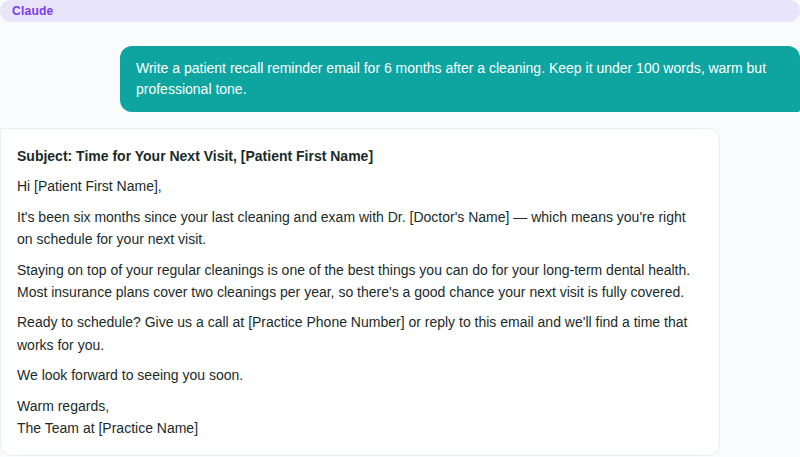
Example output from Claude for Prompt 1, unedited.
Prompt 1: Post-Cleaning Recall Reminder (6 Months)
The scenario: a patient had a cleaning six months ago and hasn’t scheduled their next appointment.
The prompt:
You are drafting an email for [Practice Name], a general dentistry practice.

Scenario: [Patient First Name] had their six-month cleaning and exam six months ago. They have not yet scheduled their next appointment. Send a recall reminder that encourages them to schedule.

Tone: professional, warm, not overly casual.
Length: under 150 words.
Include: [Patient First Name], [Doctor's Name], [Practice Phone Number], a clear call to action to schedule.
Do not include clinical advice beyond basic aftercare reminders. Do not diagnose.
The output:
Subject: Time for Your Next Visit, [Patient First Name]
Hi [Patient First Name],
It’s been six months since your last cleaning and exam with Dr. [Doctor’s Name], which means you’re right on schedule for your next visit.
Staying on top of your regular cleanings is one of the best things you can do for your long-term dental health. Most insurance plans cover two cleanings per year, so there’s a good chance your next visit is fully covered.
Ready to schedule? Give us a call at [Practice Phone Number] or reply to this email and we’ll find a time that works for you.
We look forward to seeing you soon.
Warm regards, The Team at [Practice Name]
Prompt 2: Treatment Plan Follow-Up (Patient Hasn’t Scheduled)
The scenario: a patient was diagnosed with a crown at their last visit and hasn’t scheduled the procedure.
The prompt:
You are drafting an email for [Practice Name], a general dentistry practice.

Scenario: [Patient First Name] was seen by Dr. [Doctor's Name] for an exam. Dr. [Doctor's Name] recommended a crown on [Tooth Location, e.g., upper left molar]. The patient has not yet scheduled the procedure. Send a follow-up email reminding them and encouraging them to schedule.

Tone: professional, warm, not overly casual.
Length: under 150 words.
Include: [Patient First Name], [Doctor's Name], the specific treatment recommended, [Practice Phone Number].
Do not include clinical advice beyond basic aftercare reminders. Do not diagnose.
The output:
Subject: Following Up on Your Treatment Plan, [Patient First Name]
Hi [Patient First Name],
Dr. [Doctor’s Name] recommended a crown for your [Tooth Location] at your last visit. We wanted to check in and see if you have any questions or if we can help you get that scheduled.
Delaying recommended treatment can sometimes allow a smaller issue to progress. Getting ahead of it now is usually the easier path. We’re happy to discuss timing, costs, and insurance coverage when you call.
Whenever you’re ready, reach us at [Practice Phone Number]. We’ll make it as straightforward as possible.
Looking forward to hearing from you, [Practice Name]
Prompt 3: Post-Extraction Check-In (24 Hours)
The scenario: a patient had a simple extraction yesterday.
The prompt:
You are drafting an email for [Practice Name], a general dentistry practice.

Scenario: [Patient First Name] had a simple extraction with Dr. [Doctor's Name] yesterday. Send a 24-hour check-in email to see how they're feeling and remind them of basic aftercare.

Tone: professional, warm, not overly casual.
Length: under 150 words.
Include: [Patient First Name], [Doctor's Name], [Practice Phone Number], a prompt to call if they have any concerns.
Do not include clinical advice beyond basic aftercare reminders. Do not diagnose.
The output:
Subject: Checking In After Your Procedure, [Patient First Name]
Hi [Patient First Name],
We’re checking in to see how you’re feeling after yesterday’s extraction with Dr. [Doctor’s Name]. We hope your recovery is going smoothly.
A reminder for the next few days: avoid hard or crunchy foods, keep the area clean, and try to rest as much as you can. If you experience anything unusual (significant pain, swelling that seems to be getting worse, or anything that concerns you), please don’t hesitate to reach out.
We’re here at [Practice Phone Number] if you have any questions at all. Your comfort and recovery are our priority.
Take care, The Team at [Practice Name]
Prompt 4: Insurance Benefits Expiring Reminder
The scenario: it’s late November, and the practice wants to remind patients that their unused dental insurance benefits expire December 31.
The prompt:
You are drafting an email for [Practice Name], a general dentistry practice.

Scenario: It is late November. Send an email to patients reminding them that most dental insurance benefits expire on December 31 and encouraging them to schedule before year-end if they have remaining benefits.

Tone: professional, warm, not overly casual.
Length: under 150 words.
Include: [Patient First Name], [Practice Phone Number], the December 31 deadline, a clear call to action.
Do not include clinical advice beyond basic aftercare reminders. Do not diagnose.
The output:
Subject: Don’t Let Your Dental Benefits Expire, [Patient First Name]
Hi [Patient First Name],
A quick reminder: most dental insurance plans reset on January 1, which means any unused benefits you’ve paid into this year expire on December 31.
If you have remaining coverage, now is the time to use it. Whether it’s a cleaning, a procedure you’ve been putting off, or anything Dr. [Doctor’s Name] recommended at your last visit, we can usually get you in before year-end if you schedule soon.
Call us at [Practice Phone Number]. We’re booking December appointments now and spots are filling up.
We’d love to see you before the new year.
Best, [Practice Name]
Prompt 5: New Patient Welcome Email
The scenario: a patient came in for their initial exam and the practice wants to follow up.
The prompt:
You are drafting an email for [Practice Name], a general dentistry practice.

Scenario: [Patient First Name] came in for their first appointment, an initial exam with Dr. [Doctor's Name]. Send a post-visit welcome email thanking them for choosing the practice and outlining next steps if any were discussed.

Tone: professional, warm, not overly casual.
Length: under 150 words.
Include: [Patient First Name], [Doctor's Name], [Practice Phone Number], a welcome message, placeholder for any treatment plan or follow-up discussed at the visit.
Do not include clinical advice beyond basic aftercare reminders. Do not diagnose.
The output:
Subject: Welcome to [Practice Name], [Patient First Name]
Hi [Patient First Name],
Thank you for choosing [Practice Name] for your dental care. It was great to meet you, and we hope your first visit with Dr. [Doctor’s Name] went well.
[If any treatment or follow-up was discussed: We’ll be in touch shortly with details on the next steps Dr. [Doctor’s Name] recommended. If you have questions in the meantime, we’re happy to help.]
Going forward, we’re here for everything from routine cleanings to any dental needs that come up. Don’t hesitate to reach out at [Practice Phone Number]. We’re always glad to hear from you.
Looking forward to being your dental home.
Warmly, [Practice Name]
Prompt 6: Missed Appointment Follow-Up
The scenario: a patient no-showed their appointment and needs to reschedule.
The prompt:
You are drafting an email for [Practice Name], a general dentistry practice.

Scenario: [Patient First Name] missed their scheduled appointment with Dr. [Doctor's Name] on [Date]. Send a follow-up email acknowledging the missed appointment and inviting them to reschedule.

Tone: professional, warm, not overly casual. Do not make the patient feel guilty or lectured.
Length: under 150 words.
Include: [Patient First Name], [Doctor's Name], [Practice Phone Number], the missed appointment date, a clear invitation to reschedule.
Do not include clinical advice beyond basic aftercare reminders. Do not diagnose.
The output:
Subject: We Missed You, [Patient First Name]
Hi [Patient First Name],
We noticed you weren’t able to make it to your appointment with Dr. [Doctor’s Name] on [Date]. Things come up, and we completely understand.
Whenever you’re ready, we’d love to get you back on the schedule. Give us a call at [Practice Phone Number] and we’ll find a time that works for you.
See you soon, [Practice Name]
Prompt 7: Post-Root Canal Check-In (48 Hours)
The scenario: a patient had endodontic treatment two days ago.
The prompt:
You are drafting an email for [Practice Name], a general dentistry practice.

Scenario: [Patient First Name] had a root canal with Dr. [Doctor's Name] two days ago. Send a 48-hour check-in email to see how they're feeling and reinforce key aftercare.

Tone: professional, warm, not overly casual.
Length: under 150 words.
Include: [Patient First Name], [Doctor's Name], [Practice Phone Number], a prompt to call with any concerns.
Do not include clinical advice beyond basic aftercare reminders. Do not diagnose.
The output:
Subject: How Are You Feeling After Your Root Canal, [Patient First Name]?
Hi [Patient First Name],
It’s been a couple of days since your root canal with Dr. [Doctor’s Name], and we wanted to check in on how you’re doing.
Some mild soreness and sensitivity around the treated tooth is completely normal at this stage and typically resolves within a few days to a week. Avoid chewing hard foods on that side, continue taking any prescribed medication as directed, and keep up with gentle brushing.
If you’re experiencing significant pain, noticeable swelling, or the temporary crown feels loose, please call us right away at [Practice Phone Number]. These are things we want to know about quickly.
We hope your recovery continues to go well. Reach out anytime if you have questions.
Best, Dr. [Doctor’s Name] and the Team at [Practice Name]
Note: The aftercare instructions in this example output are more specific than many practices would put in a generic email. “Any prescribed medication as directed” assumes a prescription was given, and “temporary crown feels loose” depends on whether treatment was single-visit or split-visit. Rewrite the middle paragraph to match your own post-endo instructions.
Prompt 8: Referral to Specialist Follow-Up
The scenario: the dentist referred a patient to an oral surgeon.
The prompt:
You are drafting an email for [Practice Name], a general dentistry practice.

Scenario: [Patient First Name] was seen by Dr. [Doctor's Name] and referred to an oral surgeon for [Reason for Referral, e.g., wisdom tooth extraction evaluation]. Send a follow-up email acknowledging the referral and encouraging the patient to follow through.

Tone: professional, warm, not overly casual.
Length: under 150 words.
Include: [Patient First Name], [Doctor's Name], the reason for referral as a placeholder, [Practice Phone Number], encouragement to schedule with the specialist.
Do not include clinical advice beyond basic aftercare reminders. Do not diagnose.
The output:
Subject: Following Up on Your Specialist Referral, [Patient First Name]
Hi [Patient First Name],
We wanted to follow up on the referral Dr. [Doctor’s Name] sent for [Reason for Referral]. Specialist referrals are an important part of your overall care, and we want to make sure you have everything you need to move forward.
If you haven’t already, we encourage you to contact the specialist to schedule your consultation. If you need a copy of the referral or have any questions about what to expect, give us a call at [Practice Phone Number]. We’re happy to help.
We’ll stay in touch and coordinate with the specialist as needed. Your care is a team effort.
Best, [Practice Name]
Prompt 9: Post-Surgical Complication Acknowledgment
The scenario: a patient called the practice to report unexpected swelling after implant placement.
The prompt:
You are drafting an email for [Practice Name], a general dentistry practice.

Scenario: [Patient First Name] called the practice to report unexpected swelling after an implant placement procedure performed by Dr. [Doctor's Name]. The patient is concerned. Send a follow-up email acknowledging their concern and directing them on next steps.

Tone: professional, warm, not overly casual. Express that the practice takes this seriously.
Length: under 150 words.
Include: [Patient First Name], [Doctor's Name], [Practice Phone Number], clear direction on next steps.
Do not include clinical advice beyond basic aftercare reminders. Do not diagnose.
The output:
Subject: Regarding Your Recent Concern, [Patient First Name]
Hi [Patient First Name],
Thank you for reaching out about the swelling you’re experiencing. We take any post-procedure concern seriously and want to make sure you’re okay.
Some swelling after implant placement is a normal part of the healing process. It typically peaks around 48-72 hours after the procedure and gradually improves. However, if the swelling is unusually severe, spreading, accompanied by fever, or if you’re experiencing difficulty swallowing or opening your mouth, these may indicate that further evaluation is needed.
Please call us at [Practice Phone Number] as soon as possible so Dr. [Doctor’s Name] can evaluate your situation. If you are experiencing severe symptoms, please seek emergency care immediately.
We’re here to help and want to ensure your recovery goes well.
Sincerely, [Practice Name]
Note: This example output explains what post-implant swelling normally looks like before directing the patient to come in. Even if the explanation is accurate, it reads as reassurance before the patient has been seen, and a patient who sees that swelling “typically peaks around 48-72 hours” may wait when same-day evaluation is warranted. For a reported complication after surgery, the safer email acknowledges the concern and gets the patient in the door, with the clinical conversation happening in person. Any communication about a possible complication should be written or reviewed by a clinician, not drafted from a template.
Prompt 10: Reactivation Email (12+ Months Inactive)
The scenario: a patient hasn’t been in for more than a year.
The prompt:
You are drafting an email for [Practice Name], a general dentistry practice.

Scenario: [Patient First Name] was last seen [Last Visit Date, e.g., "in January 2025"] for [Last Procedure, e.g., "a cleaning and exam"]. They have not been back since. Send a reactivation email that invites them to return without making them feel guilty for the gap.

Tone: professional, warm, not overly casual.
Length: under 150 words.
Include: [Patient First Name], [Doctor's Name], the last visit as a reference point, [Practice Phone Number], a clear invitation to schedule.
Do not include clinical advice beyond basic aftercare reminders. Do not diagnose.
The output:
Subject: It’s Been a While. We’d Love to See You, [Patient First Name]
Hi [Patient First Name],
We’ve been thinking of you. It’s been a little while since your last visit with Dr. [Doctor’s Name] in [Last Visit Date], and we wanted to reach out and say we’d love to have you back whenever you’re ready.
No pressure and no judgment. Life gets busy, and we understand that. Whether you’re due for a cleaning or want to address something that’s been on your mind, we’re here.
Give us a call at [Practice Phone Number] or reply to this email to get back on the schedule. We look forward to catching up.
Warmly, [Practice Name]
Note: “We’ve been thinking of you” reads as generic in a mass email. Add a sentence that references the patient’s last treatment, for example: “It’s been about a year since your last cleaning with Dr. [Doctor’s Name], and you might be overdue for your next one.” Specific details like this need to be in the prompt, since the model only knows what you give it.
Where AI Drafts Fit and Where They Do Not
Administrative and scheduling emails have predictable structure. Recall reminders, appointment follow-ups, insurance deadline notices, welcome emails and missed appointment outreach have a clear call to action and little clinical nuance, which makes them suited to AI first drafts. (If you are wondering whether to use Claude, ChatGPT, or Gemini for these drafts, our side-by-side look at all three on a dental treatment plan scenario shows the same prompt given to each.)
Post-procedure communication that touches clinical specifics needs your protocol. The root canal check-in example includes aftercare instructions that should be replaced with your practice’s own. The post-surgical complication example shows the model adding clinical context instead of simply acknowledging the concern and directing the patient to come in.
Reactivation emails need specifics from your records. The example is structurally sound, but generic warmth (“We’ve been thinking of you”) reads as template text. Add one specific reference to the patient’s history, which means putting that data in the prompt.
The value is speed on a first draft. Starting from a draft shortens writing time compared with a blank page. How much depends on your practice and how heavily you edit.
WARNING
Do Not AI-Draft Complication Emails
AI should not be used for clinical communication involving complications, unexpected symptoms, or anything requiring clinical judgment. Plausible-sounding clinical language in an email creates liability when it turns out to be wrong. If a patient reports a post-surgical concern, acknowledge it and get them in the door. The clinical conversation happens in person.
How to Use These Prompts in Your Practice
Copy any prompt above, fill in the brackets with the relevant patient and practice details, and paste it into Claude or ChatGPT. The example outputs here came from Claude, but the prompt structure is not specific to one model. If you are also using AI for marketing content like social posts and website copy, the same principle applies: specificity in the prompt drives quality in the output.
Always review before sending. This is especially true for any email that touches clinical topics: post-procedure check-ins, aftercare reminders, anything that references a specific treatment. The office manager or a clinical team member should have eyes on it before it goes out.
Save your customized versions. Once you’ve adjusted the AI draft to match your practice’s voice and protocol, save it. If your practice management software has a template system (Dentrix, Eaglesoft, and Open Dental all do), put the refined versions there. (The same workflow applies to review responses; save your HIPAA-safe templates once and reuse them.) The AI draft is the first pass; your saved template is what you reuse.
TIP
Save Refined Templates in Your PMS
Once you have edited an AI draft to match your practice voice and protocol, save it as a template in your practice management software. Dentrix, Eaglesoft, and Open Dental all have template systems. The AI generates the first draft once; your saved template is what you reuse for every patient.
Quick Reference: All 10 Prompts
For readers who want to grab the full prompt library without scrolling through outputs, here are all 10 prompts in one place.
1. Post-Cleaning Recall Reminder (6 Months)
You are drafting an email for [Practice Name], a general dentistry practice.

Scenario: [Patient First Name] had their six-month cleaning and exam six months ago. They have not yet scheduled their next appointment. Send a recall reminder that encourages them to schedule.

Tone: professional, warm, not overly casual.
Length: under 150 words.
Include: [Patient First Name], [Doctor's Name], [Practice Phone Number], a clear call to action to schedule.
Do not include clinical advice beyond basic aftercare reminders. Do not diagnose.
2. Treatment Plan Follow-Up (Patient Hasn’t Scheduled)
You are drafting an email for [Practice Name], a general dentistry practice.

Scenario: [Patient First Name] was seen by Dr. [Doctor's Name] for an exam. Dr. [Doctor's Name] recommended a crown on [Tooth Location, e.g., upper left molar]. The patient has not yet scheduled the procedure. Send a follow-up email reminding them and encouraging them to schedule.

Tone: professional, warm, not overly casual.
Length: under 150 words.
Include: [Patient First Name], [Doctor's Name], the specific treatment recommended, [Practice Phone Number].
Do not include clinical advice beyond basic aftercare reminders. Do not diagnose.
3. Post-Extraction Check-In (24 Hours)
You are drafting an email for [Practice Name], a general dentistry practice.

Scenario: [Patient First Name] had a simple extraction with Dr. [Doctor's Name] yesterday. Send a 24-hour check-in email to see how they're feeling and remind them of basic aftercare.

Tone: professional, warm, not overly casual.
Length: under 150 words.
Include: [Patient First Name], [Doctor's Name], [Practice Phone Number], a prompt to call if they have any concerns.
Do not include clinical advice beyond basic aftercare reminders. Do not diagnose.
4. Insurance Benefits Expiring Reminder
You are drafting an email for [Practice Name], a general dentistry practice.

Scenario: It is late November. Send an email to patients reminding them that most dental insurance benefits expire on December 31 and encouraging them to schedule before year-end if they have remaining benefits.

Tone: professional, warm, not overly casual.
Length: under 150 words.
Include: [Patient First Name], [Practice Phone Number], the December 31 deadline, a clear call to action.
Do not include clinical advice beyond basic aftercare reminders. Do not diagnose.
5. New Patient Welcome Email
You are drafting an email for [Practice Name], a general dentistry practice.

Scenario: [Patient First Name] came in for their first appointment, an initial exam with Dr. [Doctor's Name]. Send a post-visit welcome email thanking them for choosing the practice and outlining next steps if any were discussed.

Tone: professional, warm, not overly casual.
Length: under 150 words.
Include: [Patient First Name], [Doctor's Name], [Practice Phone Number], a welcome message, placeholder for any treatment plan or follow-up discussed at the visit.
Do not include clinical advice beyond basic aftercare reminders. Do not diagnose.
6. Missed Appointment Follow-Up
You are drafting an email for [Practice Name], a general dentistry practice.

Scenario: [Patient First Name] missed their scheduled appointment with Dr. [Doctor's Name] on [Date]. Send a follow-up email acknowledging the missed appointment and inviting them to reschedule.

Tone: professional, warm, not overly casual. Do not make the patient feel guilty or lectured.
Length: under 150 words.
Include: [Patient First Name], [Doctor's Name], [Practice Phone Number], the missed appointment date, a clear invitation to reschedule.
Do not include clinical advice beyond basic aftercare reminders. Do not diagnose.
7. Post-Root Canal Check-In (48 Hours)
You are drafting an email for [Practice Name], a general dentistry practice.

Scenario: [Patient First Name] had a root canal with Dr. [Doctor's Name] two days ago. Send a 48-hour check-in email to see how they're feeling and reinforce key aftercare.

Tone: professional, warm, not overly casual.
Length: under 150 words.
Include: [Patient First Name], [Doctor's Name], [Practice Phone Number], a prompt to call with any concerns.
Do not include clinical advice beyond basic aftercare reminders. Do not diagnose.
8. Referral to Specialist Follow-Up
You are drafting an email for [Practice Name], a general dentistry practice.

Scenario: [Patient First Name] was seen by Dr. [Doctor's Name] and referred to an oral surgeon for [Reason for Referral, e.g., wisdom tooth extraction evaluation]. Send a follow-up email acknowledging the referral and encouraging the patient to follow through.

Tone: professional, warm, not overly casual.
Length: under 150 words.
Include: [Patient First Name], [Doctor's Name], the reason for referral as a placeholder, [Practice Phone Number], encouragement to schedule with the specialist.
Do not include clinical advice beyond basic aftercare reminders. Do not diagnose.
9. Post-Surgical Complication Acknowledgment
You are drafting an email for [Practice Name], a general dentistry practice.

Scenario: [Patient First Name] called the practice to report unexpected swelling after an implant placement procedure performed by Dr. [Doctor's Name]. The patient is concerned. Send a follow-up email acknowledging their concern and directing them on next steps.

Tone: professional, warm, not overly casual. Express that the practice takes this seriously.
Length: under 150 words.
Include: [Patient First Name], [Doctor's Name], [Practice Phone Number], clear direction on next steps.
Do not include clinical advice beyond basic aftercare reminders. Do not diagnose.
Note: See the note under Prompt 9 above before using this prompt. Complication communication requires human clinical judgment, not AI drafting.
10. Reactivation Email (12+ Months Inactive)
You are drafting an email for [Practice Name], a general dentistry practice.

Scenario: [Patient First Name] was last seen [Last Visit Date, e.g., "in January 2025"] for [Last Procedure, e.g., "a cleaning and exam"]. They have not been back since. Send a reactivation email that invites them to return without making them feel guilty for the gap.

Tone: professional, warm, not overly casual.
Length: under 150 words.
Include: [Patient First Name], [Doctor's Name], the last visit as a reference point, [Practice Phone Number], a clear invitation to schedule.
Do not include clinical advice beyond basic aftercare reminders. Do not diagnose.
Correction, October 23, 2026. An earlier version of this article said a practice owner with years of experience graded each output, and reported counts such as “seven ready to send.” That review did not take place, and the grades, counts and quoted comments have been removed. The outputs are example Claude responses and have not been reviewed or validated by anyone.
Sources
Independent. We verify regulatory claims against the FDA 510(k) database and link every filing. Found an error? Email [email protected]; corrections are logged on our editorial policy page.